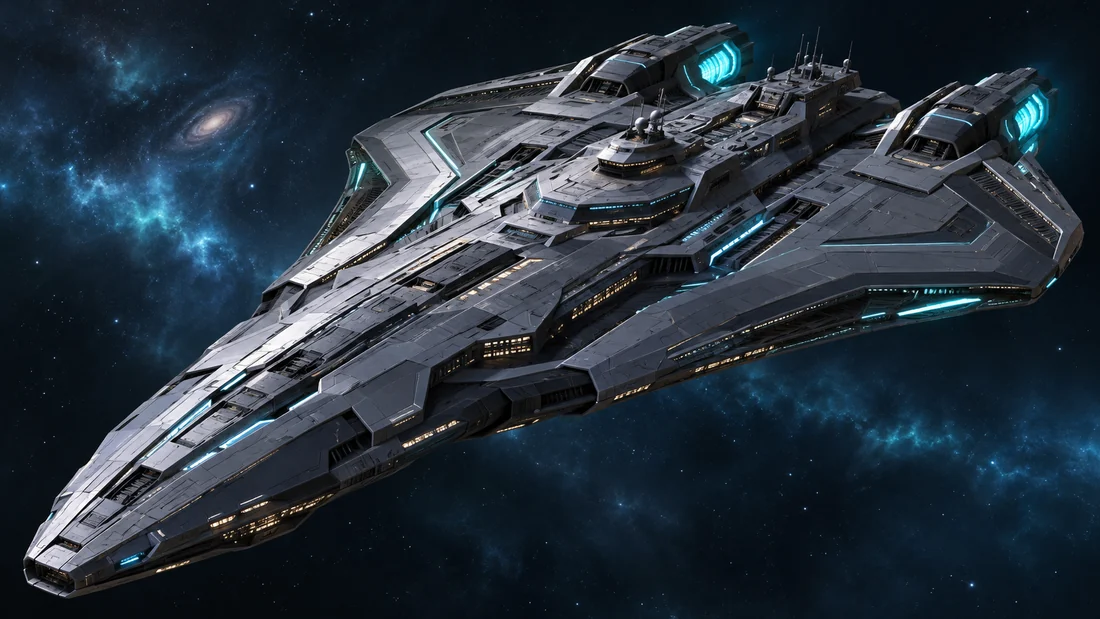
In Zorak’s current simulation, a single 180-second KETS command added 1,828 N·s of forward impulse over ordinary propulsion by the end of a five-minute comparison. For the 900,000-tonne flagship and its docked load, that gave 2.03 micrometres per second of extra speed.
Original engine trial of 23 November
This earlier simulation held fusion output at 213.19 MW and assumed the diverted charged particles were surplus to plasma heating. Wing A ramped up first, then wing B. Each branch diverted 5 MW during a two-minute full-power hold. The replay shows one-second readings from that run.
The model gives a 5.65% thrust increase, about 58 N, with KETS circulation included. The bypass reference has its KCS pumps off. During the staged return to bypass, thrust briefly dipped to 1,015 N as the conventional heat path recovered.
Planned pulse
Full diversion lasted from 20 to 140 seconds. Both branches reached bypass at 160 seconds and the modeled cooldown marker by 170.8 seconds.
With one main radiator sector out, peak main-loop heat was 186.62 MW against 193.82 MW available after reserve. That left 7.20 MW of headroom, with zero heat stored in either external KCS buffer.
Fusion A cooling fault
When Fusion A lost its spare KCS bank at 60 seconds, A returned to bypass while its primary radiator continued cooling. Its buffer peaked at 0.58 MJ and the branch reached its cooldown marker at 75 seconds.
Fusion B continued the pulse. Combined thrust settled near 1,056 N after the handover.
What could prevent the gain?
In the warmer crew-cooling case, the available train could reject 1.24 MW against 1.33 MW of demand, so startup was held. In the full plasma-reheating case, a 12.50 MW heater load reduced the modeled net bus to 55.01 MW, below the 63.96 MW bypass reference.
Cooling and verification assumptions
Each branch has a 1.00 MW primary KCS bank, a 0.55 MW spare bank, a 100 MJ external buffer and a 50 kW circulation load. The conventional heat path and converter heat release each use an assumed five-second response. The cooldown marker requires residual converter heat release to fall to 5% of full load and its buffer to be discharged. Physical thrust, radiator performance and cooldown still require measurement.
Speed comparisons · Updated
How much speed did KETS add?
Zorak’s stern drives produce thrust even in bypass. To isolate the contribution from KETS, each comparison subtracts the speed gained in bypass from the speed gained with recovery active over the same interval.
Additional speed over bypass for each model’s mass and time window
Run
Assumed vessel mass
Extra speed from KETS
Current single boost from rest, including cooldown to 300 seconds
900,000 tonnes loaded
0.00203 mm/s
Original 160-second pulse from rest
690,000 tonnes
0.0118 mm/s
180-second cruise comparison at 0.075c, departure frame
654,591 tonnes
0.01416 mm/s
In the loaded-ship case, the ordinary engines were already running when the boost began. The model held propellant flow and other ship services equal in both runs and included the power for replacement plasma heating. The advantage reached 2,016 N·s at command cutoff, then fell to 1,828 N·s as the conventional heat path recovered and both cooling pumps continued to run.
For the original 160-second pulse, summing the thrust difference over the one-second replay intervals gives approximately 8,160 N·s of extra impulse. This includes the brief dip during shutdown. Dividing by that trial’s assumed mass gives 0.0118 mm/s.
In the 180-second cruise comparison starting at 0.075c, the modeled gains in the departure frame of Earth and the destination are 0.29528 mm/s with KETS and 0.28112 mm/s in bypass. Their difference before rounding is 0.01416 mm/s. The retained local benchmark gives 0.29695 and 0.28271 mm/s, respectively. The Cycle applies relativistic velocity addition to express those increments in the departure frame.
Physical evidence. The original pulse and cruise projection assume surplus particle energy. All three comparisons use simulated forces. A physical test would measure axial force during matched active and bypass runs at equal fusion output and propellant flow, with heater and pump power recorded through cooldown. The difference must exceed the measurement uncertainty.
The Gen 2 power and cooling study evaluates a 99.91 MW net electrical target per wing. A Gen 2 thrust gain requires a separate matched comparison.
Earlier 50-minute formation comparison
This historical study modeled ten consecutive pulses over 3,000 seconds to estimate the thrust each major vessel would need to follow Zorak. In the current procedure a manual request starts one boost. Another boost requires a fresh request after cooldown and readiness checks.
Forward impulse and mean thrust over the matched 3,000-second window
Quantity
Loaded Zorak model
Formation demand estimate
Impulse added during commanded pulses
+20,162.46 N·s
+71,226.81 N·s
Impulse change during rundown and cooldown
−1,878.02 N·s
−6,634.38 N·s
Net impulse above bypass
+18,284.44 N·s
+64,592.43 N·s
Mean force across the KETS run, including cooldown
1,037.50 N
3,665.12 N
Mean force across the bypass run
1,031.41 N
3,643.59 N
Fleet configuration. All 18 named Gen 2 vessels have two machinery wings in the design. The ten major vessels fly independently, including the cruisers Norak and Marak in Space Mode. The eight interceptors remain docked with their drives in bypass.
Fleet thrust over 50 minutes. At a loaded mass of 3,179,380.1 tonnes, the fleet would need 21.53 N more thrust on average to follow Zorak’s KETS-assisted acceleration than to follow its bypass run. That 0.59% difference includes cooldown between pulses. Watch the full fleet replay and compare the two runs.
The calculation scales Zorak’s force profile in proportion to each independent assembly’s mass, counting docked mass once. It assumes axial exhaust, constant mass ratios and no external forces. The result estimates the thrust each hull would need. Hull-specific drive performance, post-refit masses and delivered thrust still need measurement.
When does the optional wind assist engage?
A cleared hull can request supplemental shield operation during outward departure only when the stellar wind overtakes it and the extra predicted forward impulse exceeds the drive impulse lost through cooldown. A tie, stale data or missing evidence leaves standard Outverse selected. The wind contribution is accounted separately from the fleet results above.
A slow-departure sensitivity assumes a 400 km/s wind, 5 protons/cm³ and a 25 km added disk-equivalent radius. Ideal reversal of the protons yields a net +3,721.84 N·s. With sideways deflection, the net is −537.03 N·s and the request stays off. Physical shield coupling, capture area and additional thrust remain unmeasured.
Shield-off study ·
Do the two engines gain thrust when their plumes meet?
Zorak’s synchronized KETS and engine boost ran through 10 pulses and cooldown.
With the shield disengaged, both wings together delivered 3,112,491.91 N·s
of ideal forward impulse. That equals the sum of their separate firings. Each wing kept the same power and
propellant profile in both comparisons. The model held any power freed by the shield in reserve.
Forward impulse over 3,000 seconds
Engine state
Vacuum (N·s)
Ambient plasma, assuming zero force back on the hull (N·s)
Propellant (kg)
Engines off
0.00
0.00
0.000
Wing A alone
1,556,930.00
1,556,930.00
30.843
Wing B alone
1,555,561.91
1,555,561.91
30.843
Both wings
3,112,491.91
3,112,491.91
61.686
The independent-engine model gives 0 N·s of additional impulse from firing both wings
together. The ambient-plasma column matches vacuum because it assumes zero force from the surrounding plasma back on the vessel.
That force has yet to be measured. The fleet receives 0 km/s of additional speed credit.
What if the two engines steer more exhaust straight aft?
These examples assume 98.0% of the exhaust momentum points straight aft when the wings fire separately.
Changing that share while the exhaust still exerts a force on the engines changes the forward impulse.
The actual exhaust directions are unknown.
Change from separate firings at the same energy and propellant
Joint aft share
Extra forward impulse (N·s)
Zorak speed change (µm/s)
Fleet centre-of-mass speed change (µm/s)
97.9%
−3,112.49
−3.46
−0.98
98.0%
0.00
0.00
0.00
98.1%
+3,112.49
+3.46
+0.98
These speed changes apply to loaded Zorak (900,000 tonnes) and the fleet
(3,179,380.1 tonnes) if only Zorak’s impulse changes. A micrometre per second (µm/s) is one millionth of a metre per second.
What would establish a physical gain?
Measure signed forward force on the whole vessel with engines off, each wing alone and both together.
Repeat the four states in vacuum and in characterized plasma, matching per-wing inputs and subtracting each environment’s
engines-off background. Compare the total impulse through cooldown and its measurement uncertainty.
Exhaust can transfer momentum to particles far downstream. A change in vessel speed requires force to reach the vessel.