ZENIT hierarchy
The ZENIT Master Qualification Architecture (ZMQA-R1) defines who holds authority and how access is granted across ZENIT Earth and Space.
Roles and authority
- Program owner
- Fredrik Sommerseth Olsen sets the program’s direction and authorizes publication.
- ZENIT Safety Authority
ZSA - Independently authorizes tests, manages the hazard log, accepts configuration changes, and certifies systems.
- AXIOM
- Holds the final physical safety veto and can stop an operation when safety conditions are unmet.
- NEXUS
- Supervises and coordinates operations and monitors system status.
- LSI
- Records decisions and events and presents Earth-system status in a form people can use.
Access ranks
ZENIT Access Rank (ZAR) describes a person’s access role.
| Rank | Role |
|---|---|
ZAR-A | Visitor Visits public or supervised areas under the conditions for that visit. |
ZAR-B | Personnel Carries out assigned duties in approved work areas. |
ZAR-C | Technical Works on assigned equipment within their technical qualification. |
ZAR-D | Operations Runs authorized systems and procedures while on duty. |
ZAR-E | Command Directs operations within their assigned command responsibilities. |
ZAR-F | Critical Authority Participates in specifically authorized work on critical systems or procedures. |
Security levels
ZENIT Security Level (ZSL) classifies an area or operation.
| Level | Classification |
|---|---|
ZSL-0 | Standard use Recorded for the ZC-1 car model. |
ZSL-1 | Open |
ZSL-2 | Supervised |
ZSL-3 | Internal |
ZSL-4 | Controlled Technical |
ZSL-5 | Restricted Operations |
ZSL-6 | Critical Systems |
ZSL-7 | Core and Command |
ZSL-8 | Emergency Authority |
Personal ID security
In the ZENIT access model, identity verification links a person to their access record. The facility or vessel uses the credential specified for the task.
- Qi Vanguard Fleet
QF-eID-R1 - Electronic ID (eID) is the primary crew credential. Each vessel validates it locally and puts requests tied to revoked or quarantined credentials on hold. Assigned mechanical keys support authorized fallback and maintenance. Some critical procedures require both eID and the assigned key, with AXIOM approval.
- Earth SafeSpots
- National eID verifies the first operator requesting activation. SafeSpot checks the operator’s verified qualifications and assigned role, and AXIOM determines whether activation can proceed. People seeking emergency refuge can enter under the life-safety procedure.
- Assigned-key risk chambers
- The assigned mechanical key controls entry. The chamber procedure defines secondary digital checks and any two-person requirement.
Qi Fleet credential checks
- Offline authorization. A vessel with local power can use signed credential-status records within the validity limit for the operation. It holds new restricted requests when that limit expires.
- Critical requests. For eID-controlled critical work, the crew member unlocks their credential and it answers a fresh challenge from the vessel.
- Lost credentials. A designated shipboard role can suspend an eID locally and share the suspension when fleet contact returns. Issuing a replacement requires identity verification.
A technician presents a valid fleet eID aboard another vessel. The check reports Identity verified. Access held pending a current duty assignment.
How access is granted
Restricted work requires the checks specified for the task.
- Verify the requester’s identity using the facility or vessel’s procedure.
- Match the person’s access rank to the area or operation’s security level.
- Confirm specialist authorization and a current duty assignment.
- Check the assigned key for key-controlled work and confirm a safe system state.
- Involve a second authorized person where two-person control applies.
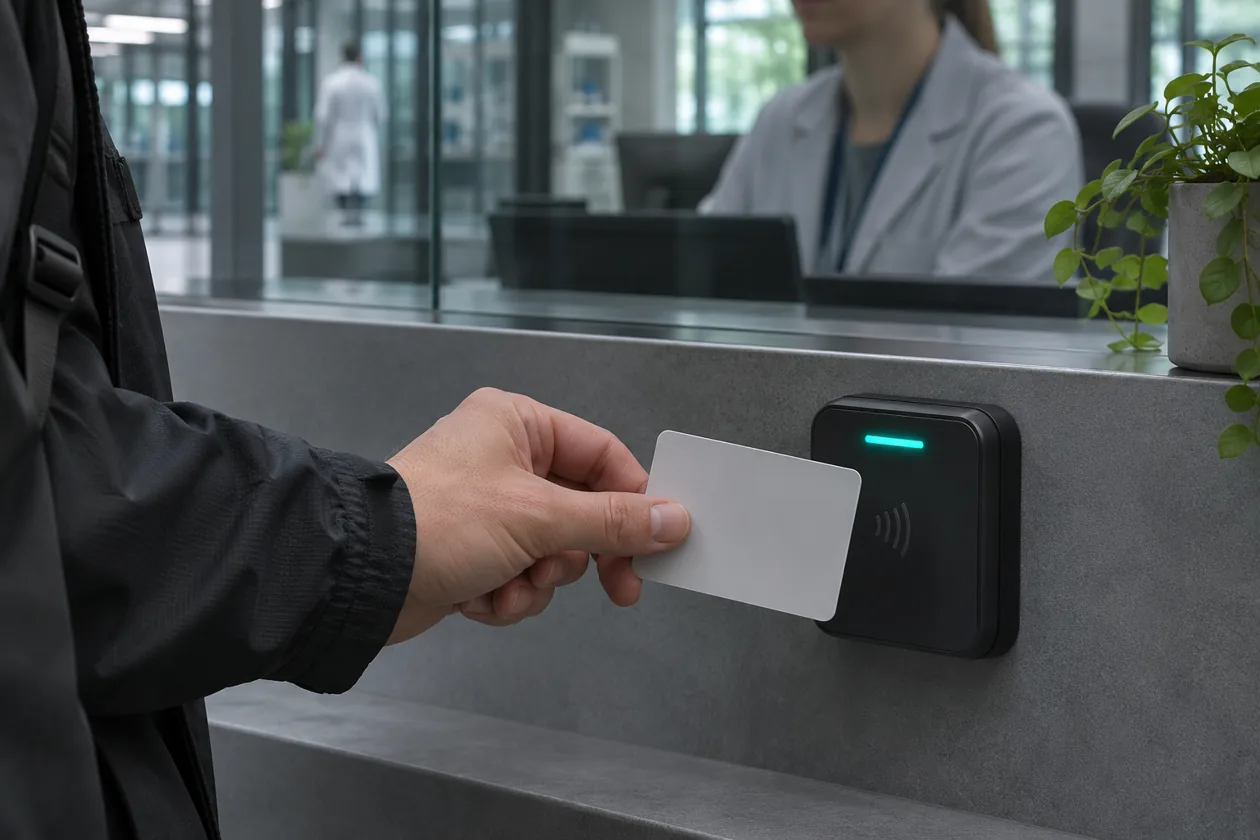
Access during power loss
Local eID checks can run while emergency power supplies the reader and safety controls. The ZENIT design provides manual access when both main and emergency power are lost.
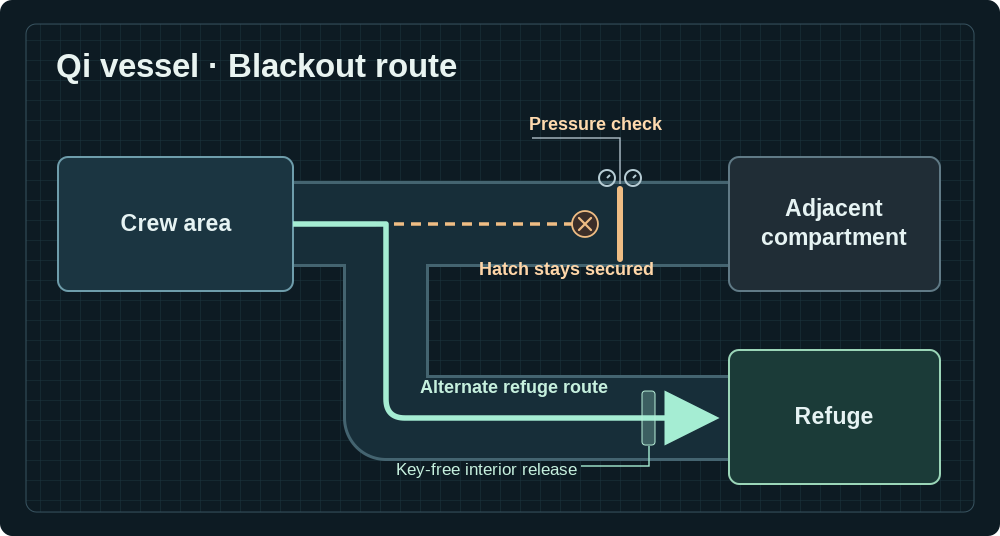
Where can the crew go in a blackout?
With the readers offline, the crew can reach a designated refuge using the interior mechanical release. In this example the pressure hatch to the adjacent compartment stays secured because safe conditions are unconfirmed. A marked alternate route leads to refuge.
Assigned keys and the local duty roster cover restricted entry. Pressure checks and independent safety requirements still apply.
See what the refuge needs to support the crew
NASA human-system reference for escape paths and hatch pressure indication- Evacuation and refuge
- People can operate key-free mechanical releases from inside on designated routes to a safe exit or refuge.
- Authorized entry
- Designated crew and responders confirm their assignments with a local paper duty roster. Their mechanical keys cover the access points assigned to those duties. A second authorized person takes part where the procedure requires two-person control.
- Pressure hatches
- The design calls for manual pressure equalization and a power-independent pressure-difference indication readable from either side. A hatch stays secured until the crew confirms a safe pressure difference and conditions on the other side. People use the designated alternate route or refuge when the hatch must stay closed.
- Critical equipment
- Each critical system is designed to reach a defined safe state on power loss. Emergency isolation uses the system’s designated local provisions. Restart requires verified safe conditions and AXIOM approval where specified.