How ZENIT decides whether a reading is trustworthy enough to act on.
Connected research: retain local records through an outage. The Trell–Fronak replay separates crossing, receipt issue, transmission and arrival times. SafeSpots, Norak and CORAC can use the same record requirements in their next ordinary-network tests.
Telemetry carries readings such as coolant flow, power reserves and vessel position. The ZENIT Telemetric Integrity Architecture (ZTIA) describes how the system checks those readings and keeps safety decisions under local control.
A SafeSpot in a Norwegian fjord and a Qi vessel near Earth face the same question. How can an operator tell what is happening when the connection is uncertain? ZENIT can combine ground and satellite links while keeping verification, records and protective decisions close to the equipment.
Concept illustration of a coastal station with a satellite terminal.
Trust starts at the measurement
A sensor reading arrives with its source, units, capture time, sequence number and quality flag. Under the ZENIT Telemetric Integrity Architecture (ZTIA), a local gateway checks the report’s integrity and age, then compares critical readings with independent instruments or physical limits. NEXUS interprets the evidence and Living Systems Intelligence (LSI) shows Earth operators its quality and age. The receiver checks freshness again because a reading can expire on its way there.
The same checked report can travel by fibre, microwave or satellite. The remote reporting path carries selected status, with authenticated messages and access limited to authorized recipients. Commands use a separate authorization path. AXIOM retains physical authority within the site or vessel, and hardwired local protection can act during a communications outage.
Choose a link for each location
Terrestrial and undersea fibre can carry reports between continents. Satellite service extends coverage to remote sites and vessels offshore, and gives connected facilities another route during outages.
[1]
Proposed Earth link plan
Location
Reporting path
Earth Research Facility
Fibre for routine reports. Microwave provides a second ground route. A satellite terminal can send essential updates when both ground routes are unavailable.
Remote SafeSpot or offshore platform
Satellite as the main link beyond reliable ground coverage. Use fibre, cellular or radio where available and retain a local event record.
The first pilot can use an existing satellite service. The site terminal sends reports through the satellite network, whose ground gateway hands them back to a terrestrial network for delivery to ZENIT operators. For a northern site, check the provider’s coverage at the actual location and test the view of the sky from the proposed antenna position. Geostationary satellites can sit low on the horizon at high latitudes, where terrain can block the signal.
[2]
Follow a SafeSpot reading through an outage
Measure and verify. A water-level sensor reports a drop. The gateway checks the timestamp and compares the change with another measurement. The local operator sees the result in LSI.
Send the priority report. The normal route is fibre. If the ground routes drop, the gateway sends the essential alert and current status via satellite when that link is available. Routine logs wait for capacity.
Keep a local record. If every outward link drops, the station uses local power to keep measuring and recording. The remote display marks the site as disconnected and shows the age of its last reading. Local protection continues to act on local evidence.
Resume with fresh evidence. When a link returns, the gateway sends the current status and forwards the missed events with their original timestamps. The receiver recognizes duplicate reports by their event IDs. An expired reading belongs in the event history.
On Zorak, QFTU-7 checks readings from the primary and secondary System Buses. The Telemetry Coordination Chamber shows NEXUS assessments and AXIOM’s state to the crew. Selected reports travel in a Fleet State Package, while the protected recorder keeps the evidence onboard.
Near Earth, a compatible ground station can receive a direct transmission when it has the vessel in view. A compatible relay can extend contact between passes. Farther away, plan for mission-specific antennas, contact windows and signal delays. Delay-tolerant networking can hold reports and forward them at the next available contact.
[3][4]
Concept illustration of a communications relay in Earth orbit.
How ZENIT could build and test it
Start with one facility and one remote SafeSpot. Pick a small set of readings such as water level, ventilation and reserve power. Set a maximum useful age for each reading and decide which alerts must be sent first.
Test the links and the gaps. Check coverage, antenna sightlines, backup power and shared dependencies between routes. Disconnect each route, then all routes together. Inject late, duplicate and out-of-order reports. Measure alert delivery time, switchover time and how much of the event log reaches the receiver after reconnection.
Expand after acceptance. Have the ZENIT Safety Authority witness the fault tests and verify that local protection remains independent. Use the same checks on a Qi vessel simulator before testing a ground or relay link. Report coverage and performance for the sites and routes actually tested.
Step inside the Earth Research Facility’s NEXUS and LSI suite. The cutaway follows SafeSpot and campus readings from the intake racks to the operator desks, the event recorder and regional reporting.
Receive campus readings
The intake cabinet receives local instrument feeds for water, ventilation, reserve power and the surrounding environment. A gateway adapts signals from existing equipment and preserves source identity and measurement time.
Check the evidence
The verification rack checks identity, age, sequence and integrity. NEXUS compares readings with physical limits and independent measurements, then passes on the confidence and any flags.
Read the LSI wall
The shared display groups water, air and reserve-power readings. Each panel shows the condition and the quality of its supporting data, so the operator can spot a change or a missing feed.
Review a stale reading
The water-level reading expires. The console flags its age and holds the affected status update while the operator asks for a fresh sample. AXIOM and hardwired protection remain available through their local paths.
Keep the event record
The protected recorder keeps the source, measurement time, stale-data flag and operator acknowledgement. A later reading adds to the record so the decision can be reconstructed.
Report verified status
After checking a fresh water-level reading, the operator clears the reporting hold. The regional gateway sends the selected facility status through the campus reporting network.
The room is a proposed fit-out of the campus NEXUS and LSI suite. The displays and stale-reading exercise use illustrative data.
Explore the Qi Vanguard flagship’s proposed Telemetry Coordination Chamber (TCC). The deck cutaway shows the crew consoles, independent bus feeds, communications and protected recorder next to a mission operations passage.
Receive both bus feeds
The primary and secondary System Buses enter at separate interfaces. The QFTU-7 checks the readings and passes eligible reports and quality flags to the chamber.
Cross-check vessel health
The diagnostic console shows NEXUS assessments of vessel systems alongside the readings that support them. The crew can review conflicts and check the age of the evidence.
Read AXIOM authority
The centre console displays AXIOM’s authority state. In this example, AXIOM shows HOLD for a proposed change while a coolant reading is stale. The TCC crew can review the evidence. AXIOM retains physical authority.
Send fleet status
The communications console prepares selected, verified status for the Fleet State Package. The crew checks the recipient and link before sending the package.
Use the backup link
The primary outbound link drops. The crew checks the secondary conventional link before resuming status reports. Local bus monitoring and the independent safety path stay active in this scenario.
Reconstruct the event
The protected recorder retains the readings, AXIOM status and link change with timestamps. The crew can review their order at the reconstruction station while reporting continues over the backup link.
This proposed Zorak deck layout uses the original TCC positioning principles. The displays and link-loss exercise use illustrative data.
Follow readings across the proposed Earth Research Facility. The cutaway opens the NEXUS and LSI suite and traces links to the SafeSpot services, observation mast and independent safety island.
Measure campus conditions
SafeSpot instruments report water, ventilation and reserve power. The observation mast contributes infrared and environmental readings. Local nodes attach the source identity and measurement time.
Verify incoming readings
A gateway at the NEXUS and LSI suite adapts signals from existing instruments. The verification rack checks source, age, sequence, message integrity and plausibility. It flags stale or conflicting readings for review.
Give operators a local view
NEXUS correlates the readings that pass verification. LSI shows conditions and confidence at the operator consoles. An on-site recorder keeps the readings and decisions for review.
Share regional status
The reporting gateway sends selected facility status over campus fibre or a proposed microwave link at the observation mast. A separate voice radio supports emergency coordination.
Operate through link loss
Both regional data routes are down. Protected SERAT power sustains local monitoring and event recording in this scenario. AXIOM and hardwired protection retain authority for local isolation.
Recheck and reconnect
The operator confirms fresh readings and checks the restored link before resuming regional status reports. The time-stamped outage record stays available for review.
Local protection
The independent safety island issues protective trips on a dedicated circuit. The operations room can see their status in LSI.
Regional reporting
Fibre and microwave carry selected facility status. The operations team can use the separate voice radio for emergency coordination.
The cutaway uses the Earth Research Facility campus geometry. Telemetry equipment placement, routes and the link outage are illustrative.
In the ZC-1 electronics cooling study, stale coolant data put the SERAT scheduler into HOLD.
Read the coolant flow
SERAT checks the latest flow reading, its age and its quality alongside coolant and equipment temperatures.
Flag the stale value
A stored reading can still look normal after it expires. The scheduler needs fresh evidence of cooling capacity before admitting new loads.
Hold and verify recovery
HOLD blocks new load requests and reports the reason. Readmission requires valid readings and sustained cooling. Independent local protection handles trips.
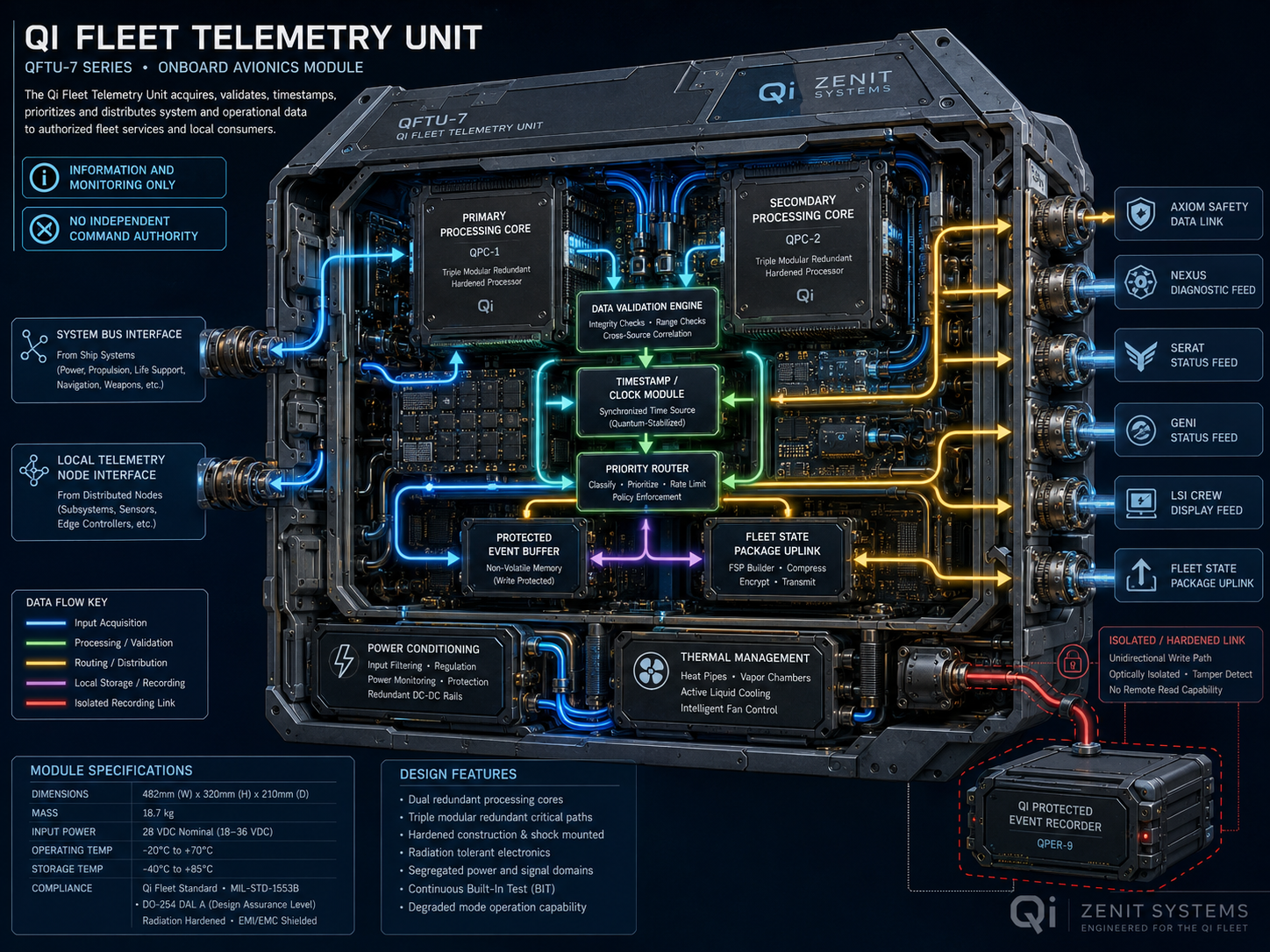
Explore the Qi Fleet Telemetry Unit cutaway. Follow a reading from the vessel’s sensors through the ZTIA checks, then see how it reaches operators, the event recorder and local safety systems.
Distributed vessel sensors and local nodes send readings such as coolant flow, pressure and position over the System Bus. The QFTU-7 receives the readings at its bus and sensor interfaces.
Identify and timestamp
Attach source identity, capture time, sequence number, expiry and a quality flag. A reading can look normal even after its time limit has passed.
Check integrity and plausibility
The concept has primary and secondary processing cores. Compare critical reports with independent sensors and physical limits. Flag stale or conflicting readings and quarantine suspect packets.
Route and interpret
The priority router distributes eligible reports. NEXUS interprets the evidence and reports its confidence. Selected status can be bundled into a Fleet State Package for authorized recipients.
Record the event
An isolated write path takes event data from the buffer to the protected event recorder. Keep the reading, its quality flags and the decision trace available for review.
Apply local safety limits
AXIOM validates any proposed physical action and local protection can act during link loss. The QFTU-7 provides monitoring and data. Record the local outcome and check fresh readings before restoring restricted operation.
Protected recording
The router sends event data through the buffer to the recorder on its isolated write path.
Local protection and feedback
Local sensors and safety controllers remain available to the equipment during a telemetry link loss. Fresh measurements go through the same checks on the next cycle.
The cutaway uses schematic geometry from the QFTU-7 design concept. Hardware and communications qualification remain open.
Original QFTU-7 cutaway
Original Qi Fleet Telemetry Unit concept artwork. Labels and specifications in the drawing are design proposals.Open full size ↗Scroll the drawing sideways for its labels.
ZTIA gives each report an identity and makes uncertainty visible to operators.
Identify the source
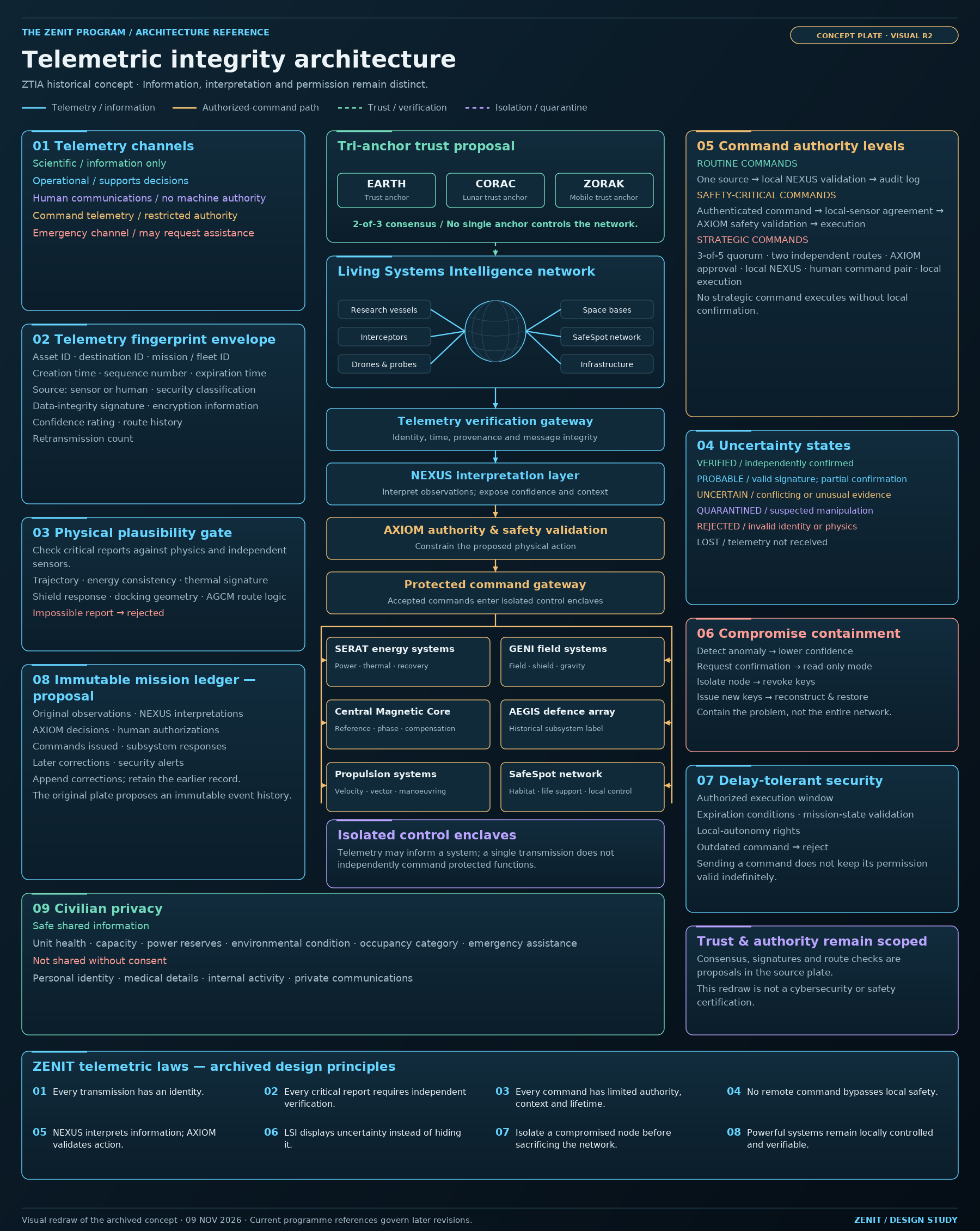
Record the vessel, session, sequence, event ID and time of observation. Authenticate the message, check its age and keep retries linked to the original event.
Check that the reading makes sense
Compare critical reports with independent sensors and physical limits, such as whether a reported manoeuvre fits the measured trajectory.
Show what the evidence supports
NEXUS displays channel agreement, independent reference validity and freshness separately. Record message receipt, evidence acceptance and verified physical outcome as separate events.
Keep action within local limits
AXIOM validates proposed physical actions. Local protection can act during a link loss, and the ZENIT Safety Authority (ZSA) governs independent test acceptance.
Shared frequency and message arrival
Radio carries essential fleet reports. An optical route can take over when pointing and geometry permit. With no suitable link, keep reports aboard and forward them with their original observation times when contact returns.
A shared GENI frequency reference remains a separate experimental model. If Trell chooses HOLD, Fronak needs a report carrying that choice. Record when each report is observed, sent and received, and keep a missing reply pending.
The July ZTIA concept proposed Earth, CORAC and Zorak as trust anchors with a two-of-three quorum. Strategic commands had a separate three-of-five proposal with independent routes, human authorization and local confirmation. The drawing also proposed a mission ledger that retains original observations and adds corrections as new entries.
Living Systems Intelligence (LSI) presents facility and environmental conditions to operators. The ZENIT SafeSpot Telemetry Network (ZSTN) concept shares facility status such as power reserves, air quality, water, capacity and emergency alerts. Sharing personal or medical details requires consent in the ZTIA concept.
The Qi Fleet Telemetry Unit (QFTU-7) concept collects, timestamps and checks vessel readings. It records events and bundles selected readings into a Fleet State Package. The Telemetry Coordination Chamber (TCC) gives operators a view of vessel health, link status and recorded events.