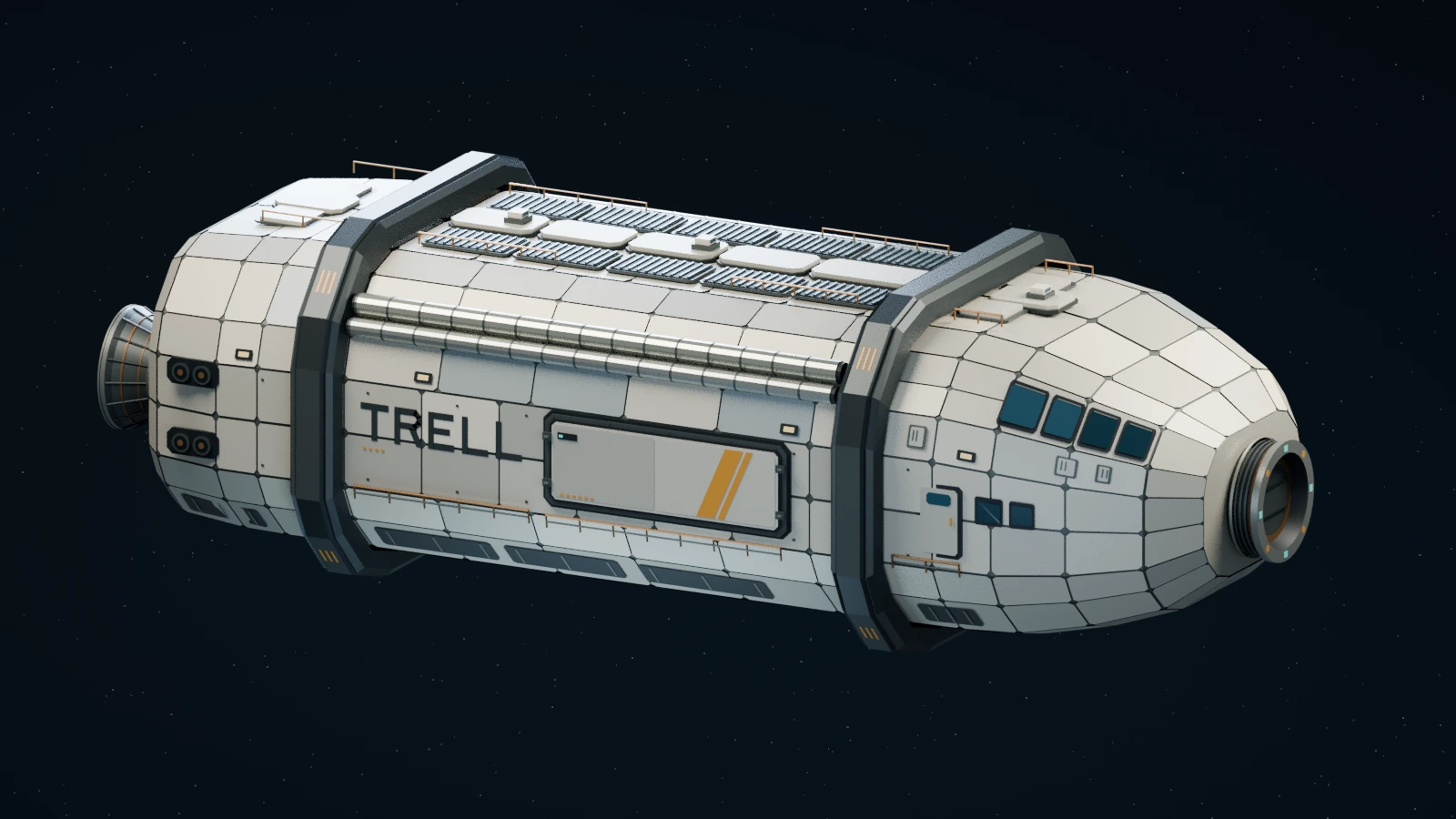
Forward starboard view. Two transverse coil housings wrap the science and supply hull.
Drag to orbit. Pinch or use + and − to zoom. With the model focused, arrow keys orbit and Home resets the view.
Hull envelope
50 × 20 × 15 m
Example mass
500 t
Design crew
20 people
Original study
January 2025
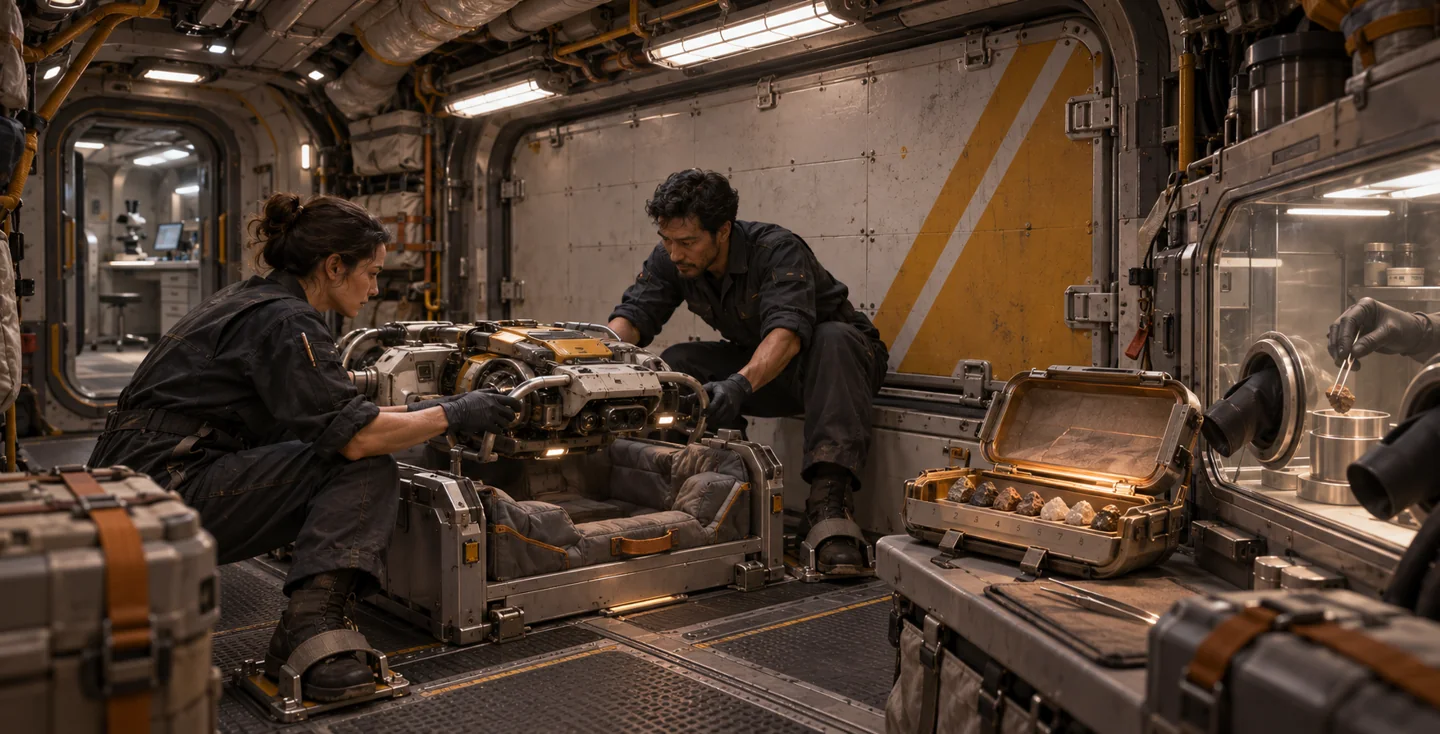
Science and cargo bay · Interior concept illustration
Mission profile
From survey drone to orbital handover
The recovered brief gives Trell laboratories, drone bays and space for supplies. In this mission example a survey drone returns a sealed sample. Trell’s science team records the collection observation and sealed canister ID. At Fronak, the receiver matches the transfer receipt before a laboratory result can be attributed to that observation.
Two pilots, six engineers, ten scientists and two medical staff make up the original crew example. Oxygen recycling, water purification and food storage support their work between visits.
The January hull dimensions guided the new exterior. The forward docking collar, cargo-door placement and visible service details are reconstruction choices.
Vehicle architecture
Where the power goes
In the original concept, a fusion-powered plasma dynamo feeds a recovery module. One electrical hub distributes its output to the shield drive, propulsion and auxiliary loads.
Dynamo and propulsion
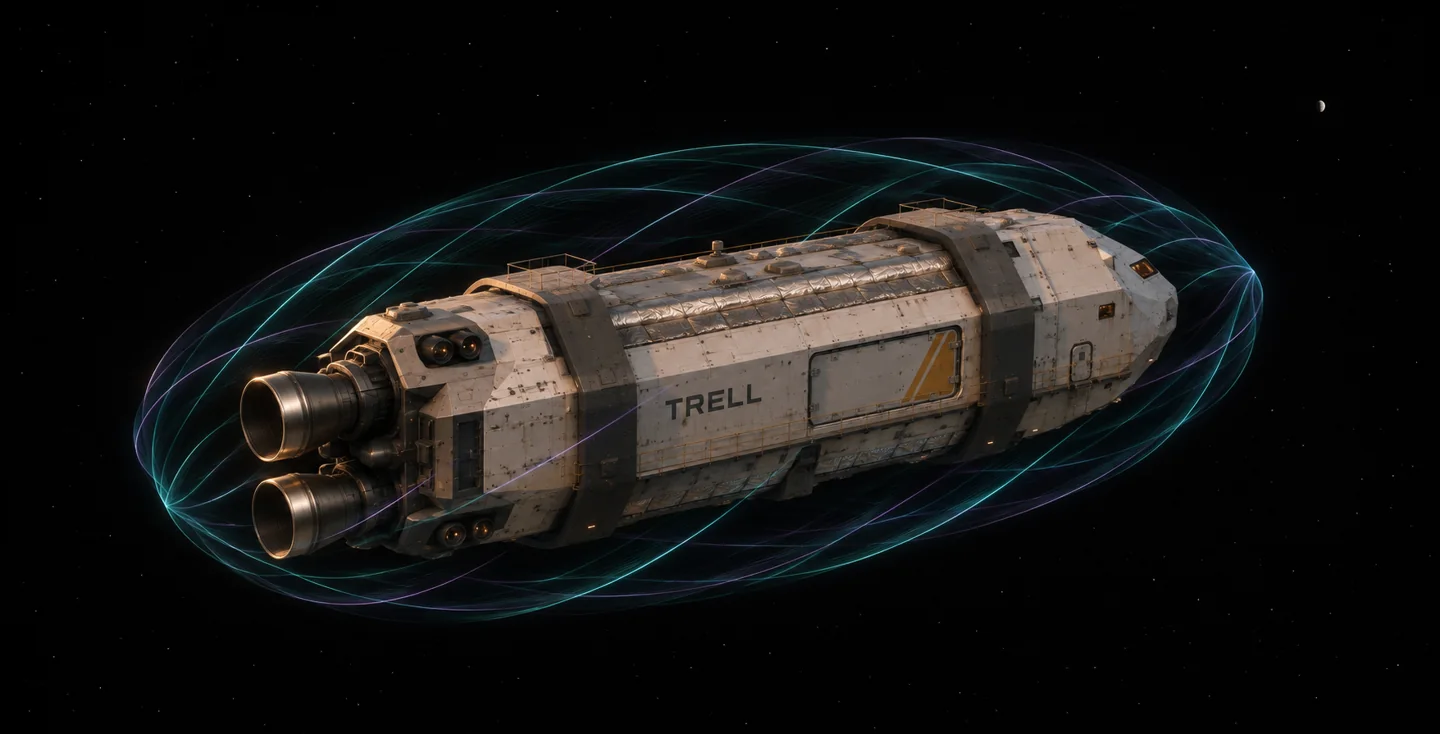
The proposed plasma dynamo supplies a recovery module and electrical hub. SERAT allocates power and cooling to Trell’s paired aft magnetic nozzles. The nozzles expel separately carried propellant. Attitude ports represent local trim during the Fronak approach. The earlier ion-thruster sketch is an archived sizing example.
Rotating shield and embedded conductors
Trell’s drawing places conductors under a rotating magnetic field. The proposed ZENIT adaptation assigns Outverse five concentric layers across five sectors, giving 25 control regions. A field command, the resulting field and crew radiation exposure each require their own evidence.
Essential services and heat
The wired hub supplies life support directly. SERAT would check power and cooling before admitting additional science loads. Useful heat counts where a customer receives it at the required temperature. The original “up to 40%” thermal recovery figure remains a design target.
Rotating-field concept · The lines illustrate the proposed field.Reactor sizing and load budget
The early vessel example used a 10 MW reactor. A separate hybrid-coil sketch used 100 MW. The records leave the thermal or electrical rating basis and continuous duty unresolved. Neither figure establishes the ship’s available bus power.
Propulsion and the Fronak approach
Follow the aft nozzles from free flight to local trim, capture and separation. Each step uses synthetic observations. The forward docking collar is reserved for capture.
The SFP-Min protocol began as a Jetnok–Frak docking study. In the proposed Trell adaptation, the visitor and host must maintain both carrier and phase lock throughout an authorized capture window.
Docking sequence
Approach and holdUse a 28.000 GHz docking reference. In the uploaded drawing, carrier error within ±2 MHz admits DOCK-HOLD. Relative speed at or below 0.5 m/s admits DOCK-SYNC.
Synchronize and openGENI permits the local shield gate to open while carrier and phase are both in tolerance. The phase limit is ±5° and the example capture window is one second.
Request captureThe reference calls for p ≥ 0.95 and closing speed ≤ 0.05 m/s. At Fronak, check fresh port translation, port rotation and main-drive neutral before requesting capture. A separate physical confirmation establishes DOCKED.
Lose lock and retryLoss of carrier or phase lock withdraws gate permission. A moving port or stale port observation also holds capture. Trell needs a fresh authorization before retrying.
Synthetic replay
Compare the decisions
These earlier cases compare the uploaded GENI statechart with the live-lock protocol. The Fronak replay below also exercises host motion, services and lab records.
Phase slips during capture
Carrier error
0 MHz
Phase error
6°
Gate level p
0.96
Relative speed
0.04 m/s
Uploaded statechart
DOCKED
Trell review
DOCK-HOLD
The last arrow on the drawing checks only gate level and speed. The recovered SFP-Min protocol also checks phase throughout the window. At 6°, GENI withdraws the open command and the craft holds for another attempt.
The crew receives capture confirmation
Carrier error
0 MHz
Phase error
0°
Gate level p
0.95
Relative speed
0.05 m/s
Uploaded statechart
DOCKED
Trell review
DOCKED
At the final sample of the scan-to-dock run, the live signal is in tolerance and both capture thresholds are met exactly. The test supplies separate capture confirmation and Trell withdraws the open command.
The carrier drifts before the gate opens
Carrier error
+3 MHz
Phase error
0°
Gate level p
0.00
Relative speed
0.04 m/s
Uploaded statechart
GATE OPEN
Trell review
DOCK-HOLD
The carrier passed its earlier check and then drifted beyond the ±2 MHz limit. The drawing allows the phase check to open the gate. Rechecking both signals at the gate keeps the command closed.
Capture is requested and confirmation is pending
Carrier error
0 MHz
Phase error
0°
Gate level p
0.96
Relative speed
0.04 m/s
Uploaded statechart
DOCKED
Trell review
GATE OPEN
Both signal locks hold. The Trell review requests capture and waits for an independent acknowledgment. A high permeability reading describes the local gate. It supplies no evidence that the two vessels have connected.
Two transitions qualify on arrival
Starting state
CRUISE
Inside docking range
Yes
Pressure ratio β
0.25
Tracking error Δω
0.06
Uploaded statechart
APPROACH or TRIM
Trell review
TRIM
The uploaded chart permits approach and trim on the same sample. The proposed Trell rule gives error correction priority. A mismatch at or below 0.03 lets a recovered trim pass through SETTLE and return to CRUISE.
Tracking limits and differences between the drawings
β is interaction pressure divided by magnetic pressure. Its target is 0.30 and its control limit is 1.00. Δω is normalized tracking error, with a target of 0.03 and a re-lock threshold of 0.10. The original normalization and sensor calculation remain open.
The companion HAB-G chart checks speed first and carrier second. This replay follows the uploaded order. The Trell adaptation gives a pressure-limit trip and error correction priority over approach, and adds independent capture confirmation.
Qi Fleet research standard · QI-FLEET-TRELL-R2
Trell–Fronak docking and sample checks
Trell stays outside Fronak. Follow a capture request, check the services needed to move a sealed canister,
and see whether Fronak can trace a lab result to its original observation.
Port still turning
Hold before captureAboard Trell0 observed crossings0 linked lab results
Port observation
Frame reported
Fronak approach F1
Measured / checked
10 s / 10 s
Port translation
0.005 m/s
Port rotation
0.3°/s
Trell closing speed
0.04 m/s
Trell main-drive readback
Neutral · 10 s
Carrier / phase error
0 MHz / 0°
Gate reading / capture window
0.96 / 10–11 s
This exercise uses Fronak approach F1 and limits of 0.01 m/s translation,
0.1°/s rotation and 2 s observation age.
Decision record
Host port · Hold before capture
Port rotation is 0.3°/s. The example limit is 0.1°/s.
Port drifting sideways
Hold before captureAboard Trell0 observed crossings0 linked lab results
Port observation
Frame reported
Fronak approach F1
Measured / checked
10 s / 10 s
Port translation
0.03 m/s
Port rotation
0.04°/s
Trell closing speed
0.04 m/s
Trell main-drive readback
Neutral · 10 s
Carrier / phase error
0 MHz / 0°
Gate reading / capture window
0.96 / 10–11 s
This exercise uses Fronak approach F1 and limits of 0.01 m/s translation,
0.1°/s rotation and 2 s observation age.
Decision record
Host port · Hold before capture
Port translation is 0.03 m/s. The example limit is 0.01 m/s.
Port observation expired
Hold before captureAboard Trell0 observed crossings0 linked lab results
Port observation
Frame reported
Fronak approach F1
Measured / checked
6 s / 10 s
Port translation
0.005 m/s
Port rotation
0.04°/s
Trell closing speed
0.04 m/s
Trell main-drive readback
Neutral · 10 s
Carrier / phase error
0 MHz / 0°
Gate reading / capture window
0.96 / 10–11 s
This exercise uses Fronak approach F1 and limits of 0.01 m/s translation,
0.1°/s rotation and 2 s observation age.
Decision record
Host port · Hold before capture
A current, time-stamped host-port observation is required.
Port reported in a different frame
Hold before captureAboard Trell0 observed crossings0 linked lab results
Port observation
Frame reported
Unaligned maintenance frame
Measured / checked
10 s / 10 s
Port translation
0.005 m/s
Port rotation
0.04°/s
Trell closing speed
0.04 m/s
Trell main-drive readback
Neutral · 10 s
Carrier / phase error
0 MHz / 0°
Gate reading / capture window
0.96 / 10–11 s
This exercise uses Fronak approach F1 and limits of 0.01 m/s translation,
0.1°/s rotation and 2 s observation age.
Decision record
Host port · Hold before capture
The port reading does not identify the agreed approach frame.
Capture witness missing
Hold transferAboard Trell0 observed crossings0 linked lab results
Port observation
Frame reported
Fronak approach F1
Measured / checked
10 s / 10 s
Port translation
0.005 m/s
Port rotation
0.04°/s
Trell closing speed
0.04 m/s
Trell main-drive readback
Neutral · 10 s
Carrier / phase error
0 MHz / 0°
Gate reading / capture window
0.96 / 10–11 s
This exercise uses Fronak approach F1 and limits of 0.01 m/s translation,
0.1°/s rotation and 2 s observation age.
Decision record
Host port · Capture requested
The signal, closing speed, main-drive neutral and host-port motion pass the example checks.
Dock services and reserves · Hold transfer
Independent capture evidence is pending.
Aft nozzle pair still active at capture
Hold before captureAboard Trell0 observed crossings0 linked lab results
Port observation
Frame reported
Fronak approach F1
Measured / checked
10 s / 10 s
Port translation
0.005 m/s
Port rotation
0.04°/s
Trell closing speed
0.04 m/s
Trell main-drive readback
Active · 10 s
Carrier / phase error
0 MHz / 0°
Gate reading / capture window
0.96 / 10–11 s
This exercise uses Fronak approach F1 and limits of 0.01 m/s translation,
0.1°/s rotation and 2 s observation age.
Decision record
Host port · Hold before capture
Capture requires a current Trell main-drive neutral readback.
Main-drive neutral expired during handover
Hold transferAboard Trell0 observed crossings0 linked lab results
Port observation
Frame reported
Fronak approach F1
Measured / checked
10 s / 10 s
Port translation
0.005 m/s
Port rotation
0.04°/s
Trell closing speed
0.04 m/s
Trell main-drive readback
Neutral · 10 s
Carrier / phase error
0 MHz / 0°
Gate reading / capture window
0.96 / 10–11 s
This exercise uses Fronak approach F1 and limits of 0.01 m/s translation,
0.1°/s rotation and 2 s observation age.
Decision record
Host port · Capture requested
The signal, closing speed, main-drive neutral and host-port motion pass the example checks.
Capture · Docked
The crew supplied independent physical capture evidence for this request.
Dock services and reserves · Hold transfer
Transfer requires a current Trell main-drive neutral readback.
Dock service readbacks
Local service readings used for this release check
Connection
For this mission
Readback
Mechanical lock
Required
Verified
Pressure seal
Required
Verified
Power
Optional
Isolated
Coolant
Optional
Isolated
Data
Optional
Isolated
Magnetic reference link
Optional
Isolated
Vessel reserves and receiving readiness
Synthetic release evidence at 20 s
Resource or facility
Example status
Essential reserves on Trell
Ready
Essential reserves on Fronak
Ready
Fronak receiving cradle
Ready
Fronak receiving store
Ready
Trell main-drive neutral
Hold
The reserve check includes essential electrical load, energy available and the protected thermal margin
on each vessel. The receiving cradle and store have separate readiness records.
Shared coolant offline, local cooling sufficient
Result linkedFronak receiving cradle1 observed crossing1 linked lab result
Port observation
Frame reported
Fronak approach F1
Measured / checked
10 s / 10 s
Port translation
0.005 m/s
Port rotation
0.04°/s
Trell closing speed
0.04 m/s
Trell main-drive readback
Neutral · 10 s
Carrier / phase error
0 MHz / 0°
Gate reading / capture window
0.96 / 10–11 s
This exercise uses Fronak approach F1 and limits of 0.01 m/s translation,
0.1°/s rotation and 2 s observation age.
Decision record
Host port · Capture requested
The signal, closing speed, main-drive neutral and host-port motion pass the example checks.
Capture · Docked
The crew supplied independent physical capture evidence for this request.
Dock services and reserves · Release authorized
Trell authorizes one transfer and waits for a crossing observation.
Receiving cradle · Crossing observed
Fronak observes CR-SAMPLE-LOCAL-COOLING in its receiving cradle for transfer CR-TRANSFER-LOCAL-COOLING.
Custody · Receipt matched
Fronak confirms custody of CR-SAMPLE-LOCAL-COOLING under transfer CR-TRANSFER-LOCAL-COOLING.
Laboratory · Result linked
Fronak matched the analysis to its receipt, canister and original observation.
Dock service readbacks
Local service readings used for this release check
Connection
For this mission
Readback
Mechanical lock
Required
Verified
Pressure seal
Required
Verified
Power
Optional
Isolated
Coolant
Optional
Unavailable
Data
Optional
Isolated
Magnetic reference link
Optional
Isolated
Vessel reserves and receiving readiness
Synthetic release evidence at 20 s
Resource or facility
Example status
Essential reserves on Trell
Ready
Essential reserves on Fronak
Ready
Fronak receiving cradle
Ready
Fronak receiving store
Ready
Trell main-drive neutral
Ready
The reserve check includes essential electrical load, energy available and the protected thermal margin
on each vessel. The receiving cradle and store have separate readiness records.
Compare the lab and handover records
Submitted result LAB-LOCAL-COOLING · Spectrum record local-cooling
Identifiers supplied by each record
Identifier
Collection or custody record
Lab entry
Observation or collection
OBS-LOCAL-COOLING
OBS-LOCAL-COOLING
Sealed canister
CR-SAMPLE-LOCAL-COOLING
CR-SAMPLE-LOCAL-COOLING
Transfer
CR-TRANSFER-LOCAL-COOLING
CR-TRANSFER-LOCAL-COOLING
Receiver
Fronak
Fronak
Required shared coolant offline
Hold transferAboard Trell0 observed crossings0 linked lab results
Port observation
Frame reported
Fronak approach F1
Measured / checked
10 s / 10 s
Port translation
0.005 m/s
Port rotation
0.04°/s
Trell closing speed
0.04 m/s
Trell main-drive readback
Neutral · 10 s
Carrier / phase error
0 MHz / 0°
Gate reading / capture window
0.96 / 10–11 s
This exercise uses Fronak approach F1 and limits of 0.01 m/s translation,
0.1°/s rotation and 2 s observation age.
Decision record
Host port · Capture requested
The signal, closing speed, main-drive neutral and host-port motion pass the example checks.
Capture · Docked
The crew supplied independent physical capture evidence for this request.
Dock services and reserves · Hold transfer
Fronak needs a current readback for Coolant.
Dock service readbacks
Local service readings used for this release check
Connection
For this mission
Readback
Mechanical lock
Required
Verified
Pressure seal
Required
Verified
Power
Optional
Isolated
Coolant
Required
Unavailable
Data
Optional
Isolated
Magnetic reference link
Optional
Isolated
Vessel reserves and receiving readiness
Synthetic release evidence at 20 s
Resource or facility
Example status
Essential reserves on Trell
Ready
Essential reserves on Fronak
Ready
Fronak receiving cradle
Ready
Fronak receiving store
Ready
Trell main-drive neutral
Ready
The reserve check includes essential electrical load, energy available and the protected thermal margin
on each vessel. The receiving cradle and store have separate readiness records.
Pressure seal unverified
Hold transferAboard Trell0 observed crossings0 linked lab results
Port observation
Frame reported
Fronak approach F1
Measured / checked
10 s / 10 s
Port translation
0.005 m/s
Port rotation
0.04°/s
Trell closing speed
0.04 m/s
Trell main-drive readback
Neutral · 10 s
Carrier / phase error
0 MHz / 0°
Gate reading / capture window
0.96 / 10–11 s
This exercise uses Fronak approach F1 and limits of 0.01 m/s translation,
0.1°/s rotation and 2 s observation age.
Decision record
Host port · Capture requested
The signal, closing speed, main-drive neutral and host-port motion pass the example checks.
Capture · Docked
The crew supplied independent physical capture evidence for this request.
Dock services and reserves · Hold transfer
Fronak needs a current readback for Pressure seal.
Dock service readbacks
Local service readings used for this release check
Connection
For this mission
Readback
Mechanical lock
Required
Verified
Pressure seal
Required
Unknown
Power
Optional
Isolated
Coolant
Optional
Isolated
Data
Optional
Isolated
Magnetic reference link
Optional
Isolated
Vessel reserves and receiving readiness
Synthetic release evidence at 20 s
Resource or facility
Example status
Essential reserves on Trell
Ready
Essential reserves on Fronak
Ready
Fronak receiving cradle
Ready
Fronak receiving store
Ready
Trell main-drive neutral
Ready
The reserve check includes essential electrical load, energy available and the protected thermal margin
on each vessel. The receiving cradle and store have separate readiness records.
Receiving cradle unavailable
Hold transferAboard Trell0 observed crossings0 linked lab results
Port observation
Frame reported
Fronak approach F1
Measured / checked
10 s / 10 s
Port translation
0.005 m/s
Port rotation
0.04°/s
Trell closing speed
0.04 m/s
Trell main-drive readback
Neutral · 10 s
Carrier / phase error
0 MHz / 0°
Gate reading / capture window
0.96 / 10–11 s
This exercise uses Fronak approach F1 and limits of 0.01 m/s translation,
0.1°/s rotation and 2 s observation age.
Decision record
Host port · Capture requested
The signal, closing speed, main-drive neutral and host-port motion pass the example checks.
Capture · Docked
The crew supplied independent physical capture evidence for this request.
Dock services and reserves · Hold transfer
The pair needs confirmed interface compatibility and a ready receiving cradle.
Dock service readbacks
Local service readings used for this release check
Connection
For this mission
Readback
Mechanical lock
Required
Verified
Pressure seal
Required
Verified
Power
Optional
Isolated
Coolant
Optional
Isolated
Data
Optional
Isolated
Magnetic reference link
Optional
Isolated
Vessel reserves and receiving readiness
Synthetic release evidence at 20 s
Resource or facility
Example status
Essential reserves on Trell
Ready
Essential reserves on Fronak
Ready
Fronak receiving cradle
Hold
Fronak receiving store
Ready
Trell main-drive neutral
Ready
The reserve check includes essential electrical load, energy available and the protected thermal margin
on each vessel. The receiving cradle and store have separate readiness records.
Fronak has insufficient cooling
Hold transferAboard Trell0 observed crossings0 linked lab results
Port observation
Frame reported
Fronak approach F1
Measured / checked
10 s / 10 s
Port translation
0.005 m/s
Port rotation
0.04°/s
Trell closing speed
0.04 m/s
Trell main-drive readback
Neutral · 10 s
Carrier / phase error
0 MHz / 0°
Gate reading / capture window
0.96 / 10–11 s
This exercise uses Fronak approach F1 and limits of 0.01 m/s translation,
0.1°/s rotation and 2 s observation age.
Decision record
Host port · Capture requested
The signal, closing speed, main-drive neutral and host-port motion pass the example checks.
Capture · Docked
The crew supplied independent physical capture evidence for this request.
Dock services and reserves · Hold transfer
Release stays on HOLD: the essential thermal forecast or receiving-store readiness is incomplete.
Dock service readbacks
Local service readings used for this release check
Connection
For this mission
Readback
Mechanical lock
Required
Verified
Pressure seal
Required
Verified
Power
Optional
Isolated
Coolant
Optional
Isolated
Data
Optional
Isolated
Magnetic reference link
Optional
Isolated
Vessel reserves and receiving readiness
Synthetic release evidence at 20 s
Resource or facility
Example status
Essential reserves on Trell
Ready
Essential reserves on Fronak
Hold
Fronak receiving cradle
Ready
Fronak receiving store
Ready
Trell main-drive neutral
Ready
The reserve check includes essential electrical load, energy available and the protected thermal margin
on each vessel. The receiving cradle and store have separate readiness records.
Lab result matches the original observation
Result linkedFronak receiving cradle1 observed crossing1 linked lab result
Port observation
Frame reported
Fronak approach F1
Measured / checked
10 s / 10 s
Port translation
0.005 m/s
Port rotation
0.04°/s
Trell closing speed
0.04 m/s
Trell main-drive readback
Neutral · 10 s
Carrier / phase error
0 MHz / 0°
Gate reading / capture window
0.96 / 10–11 s
This exercise uses Fronak approach F1 and limits of 0.01 m/s translation,
0.1°/s rotation and 2 s observation age.
Decision record
Host port · Capture requested
The signal, closing speed, main-drive neutral and host-port motion pass the example checks.
Capture · Docked
The crew supplied independent physical capture evidence for this request.
Dock services and reserves · Release authorized
Trell authorizes one transfer and waits for a crossing observation.
Receiving cradle · Crossing observed
Fronak observes CR-SAMPLE-MATCHED-RESULT in its receiving cradle for transfer CR-TRANSFER-MATCHED-RESULT.
Custody · Receipt matched
Fronak confirms custody of CR-SAMPLE-MATCHED-RESULT under transfer CR-TRANSFER-MATCHED-RESULT.
Laboratory · Result linked
Fronak matched the analysis to its receipt, canister and original observation.
Dock service readbacks
Local service readings used for this release check
Connection
For this mission
Readback
Mechanical lock
Required
Verified
Pressure seal
Required
Verified
Power
Optional
Isolated
Coolant
Optional
Isolated
Data
Optional
Isolated
Magnetic reference link
Optional
Isolated
Vessel reserves and receiving readiness
Synthetic release evidence at 20 s
Resource or facility
Example status
Essential reserves on Trell
Ready
Essential reserves on Fronak
Ready
Fronak receiving cradle
Ready
Fronak receiving store
Ready
Trell main-drive neutral
Ready
The reserve check includes essential electrical load, energy available and the protected thermal margin
on each vessel. The receiving cradle and store have separate readiness records.
Compare the lab and handover records
Submitted result LAB-MATCHED-RESULT · Spectrum record matched-result
Identifiers supplied by each record
Identifier
Collection or custody record
Lab entry
Observation or collection
OBS-MATCHED-RESULT
OBS-MATCHED-RESULT
Sealed canister
CR-SAMPLE-MATCHED-RESULT
CR-SAMPLE-MATCHED-RESULT
Transfer
CR-TRANSFER-MATCHED-RESULT
CR-TRANSFER-MATCHED-RESULT
Receiver
Fronak
Fronak
Receipt and lab result arrive twice
Already linkedFronak receiving cradle1 observed crossing1 linked lab result
Port observation
Frame reported
Fronak approach F1
Measured / checked
10 s / 10 s
Port translation
0.005 m/s
Port rotation
0.04°/s
Trell closing speed
0.04 m/s
Trell main-drive readback
Neutral · 10 s
Carrier / phase error
0 MHz / 0°
Gate reading / capture window
0.96 / 10–11 s
This exercise uses Fronak approach F1 and limits of 0.01 m/s translation,
0.1°/s rotation and 2 s observation age.
Decision record
Host port · Capture requested
The signal, closing speed, main-drive neutral and host-port motion pass the example checks.
Capture · Docked
The crew supplied independent physical capture evidence for this request.
Dock services and reserves · Release authorized
Trell authorizes one transfer and waits for a crossing observation.
Receiving cradle · Crossing observed
Fronak observes CR-SAMPLE-REPEAT-RECORD in its receiving cradle for transfer CR-TRANSFER-REPEAT-RECORD.
Custody · Receipt matched
Fronak confirms custody of CR-SAMPLE-REPEAT-RECORD under transfer CR-TRANSFER-REPEAT-RECORD.
Laboratory · Result linked
Fronak matched the analysis to its receipt, canister and original observation.
Custody · Receipt already matched
A duplicate receipt matches the confirmed handover.
Laboratory · Already linked
The repeated lab record refers to the same accepted result.
Dock service readbacks
Local service readings used for this release check
Connection
For this mission
Readback
Mechanical lock
Required
Verified
Pressure seal
Required
Verified
Power
Optional
Isolated
Coolant
Optional
Isolated
Data
Optional
Isolated
Magnetic reference link
Optional
Isolated
Vessel reserves and receiving readiness
Synthetic release evidence at 20 s
Resource or facility
Example status
Essential reserves on Trell
Ready
Essential reserves on Fronak
Ready
Fronak receiving cradle
Ready
Fronak receiving store
Ready
Trell main-drive neutral
Ready
The reserve check includes essential electrical load, energy available and the protected thermal margin
on each vessel. The receiving cradle and store have separate readiness records.
Compare the lab and handover records
Submitted result LAB-REPEAT-RECORD · Spectrum record repeat-record
Identifiers supplied by each record
Identifier
Collection or custody record
Lab entry
Observation or collection
OBS-REPEAT-RECORD
OBS-REPEAT-RECORD
Sealed canister
CR-SAMPLE-REPEAT-RECORD
CR-SAMPLE-REPEAT-RECORD
Transfer
CR-TRANSFER-REPEAT-RECORD
CR-TRANSFER-REPEAT-RECORD
Receiver
Fronak
Fronak
Lab result names another canister
Result withheldFronak receiving cradle1 observed crossing0 linked lab results
Port observation
Frame reported
Fronak approach F1
Measured / checked
10 s / 10 s
Port translation
0.005 m/s
Port rotation
0.04°/s
Trell closing speed
0.04 m/s
Trell main-drive readback
Neutral · 10 s
Carrier / phase error
0 MHz / 0°
Gate reading / capture window
0.96 / 10–11 s
This exercise uses Fronak approach F1 and limits of 0.01 m/s translation,
0.1°/s rotation and 2 s observation age.
Decision record
Host port · Capture requested
The signal, closing speed, main-drive neutral and host-port motion pass the example checks.
Capture · Docked
The crew supplied independent physical capture evidence for this request.
Dock services and reserves · Release authorized
Trell authorizes one transfer and waits for a crossing observation.
Receiving cradle · Crossing observed
Fronak observes CR-SAMPLE-WRONG-RESULT in its receiving cradle for transfer CR-TRANSFER-WRONG-RESULT.
Custody · Receipt matched
Fronak confirms custody of CR-SAMPLE-WRONG-RESULT under transfer CR-TRANSFER-WRONG-RESULT.
Laboratory · Result withheld
The lab identifiers disagree with the collection record or accepted handover.
Dock service readbacks
Local service readings used for this release check
Connection
For this mission
Readback
Mechanical lock
Required
Verified
Pressure seal
Required
Verified
Power
Optional
Isolated
Coolant
Optional
Isolated
Data
Optional
Isolated
Magnetic reference link
Optional
Isolated
Vessel reserves and receiving readiness
Synthetic release evidence at 20 s
Resource or facility
Example status
Essential reserves on Trell
Ready
Essential reserves on Fronak
Ready
Fronak receiving cradle
Ready
Fronak receiving store
Ready
Trell main-drive neutral
Ready
The reserve check includes essential electrical load, energy available and the protected thermal margin
on each vessel. The receiving cradle and store have separate readiness records.
Compare the lab and handover records
Submitted result LAB-WRONG-RESULT · Spectrum record wrong-result
Identifiers supplied by each record
Identifier
Collection or custody record
Lab entry
Observation or collection
OBS-WRONG-RESULT
OBS-WRONG-RESULT
Sealed canister
CR-SAMPLE-WRONG-RESULT
CS-OTHER
Transfer
CR-TRANSFER-WRONG-RESULT
CR-TRANSFER-WRONG-RESULT
Receiver
Fronak
Fronak
A late receipt releases a pending lab result
Result linkedFronak receiving cradle1 observed crossing1 linked lab result
Port observation
Frame reported
Fronak approach F1
Measured / checked
10 s / 10 s
Port translation
0.005 m/s
Port rotation
0.04°/s
Trell closing speed
0.04 m/s
Trell main-drive readback
Neutral · 10 s
Carrier / phase error
0 MHz / 0°
Gate reading / capture window
0.96 / 10–11 s
This exercise uses Fronak approach F1 and limits of 0.01 m/s translation,
0.1°/s rotation and 2 s observation age.
Decision record
Host port · Capture requested
The signal, closing speed, main-drive neutral and host-port motion pass the example checks.
Capture · Docked
The crew supplied independent physical capture evidence for this request.
Dock services and reserves · Release authorized
Trell authorizes one transfer and waits for a crossing observation.
Receiving cradle · Crossing observed
Fronak observes CR-SAMPLE-LATE-RECEIPT in its receiving cradle for transfer CR-TRANSFER-LATE-RECEIPT.
Laboratory · Result withheld
Fronak’s matched custody receipt is still pending.
Custody · Receipt matched
Fronak confirms custody of CR-SAMPLE-LATE-RECEIPT under transfer CR-TRANSFER-LATE-RECEIPT.
Laboratory · Result linked
Fronak matched the analysis to its receipt, canister and original observation.
Dock service readbacks
Local service readings used for this release check
Connection
For this mission
Readback
Mechanical lock
Required
Verified
Pressure seal
Required
Verified
Power
Optional
Isolated
Coolant
Optional
Isolated
Data
Optional
Isolated
Magnetic reference link
Optional
Isolated
Vessel reserves and receiving readiness
Synthetic release evidence at 20 s
Resource or facility
Example status
Essential reserves on Trell
Ready
Essential reserves on Fronak
Ready
Fronak receiving cradle
Ready
Fronak receiving store
Ready
Trell main-drive neutral
Ready
The reserve check includes essential electrical load, energy available and the protected thermal margin
on each vessel. The receiving cradle and store have separate readiness records.
Compare the lab and handover records
Submitted result LAB-LATE-RECEIPT · Spectrum record late-receipt
Identifiers supplied by each record
Identifier
Collection or custody record
Lab entry
Observation or collection
OBS-LATE-RECEIPT
OBS-LATE-RECEIPT
Sealed canister
CR-SAMPLE-LATE-RECEIPT
CR-SAMPLE-LATE-RECEIPT
Transfer
CR-TRANSFER-LATE-RECEIPT
CR-TRANSFER-LATE-RECEIPT
Receiver
Fronak
Fronak
Drawing sources and qualification
Fronak’s July docking drawing requires a steady port. The exercise measures port motion against the agreed local approach axes.
Both vessels may travel together in orbit. The 0.00 m/s on the drawing is an illustrated reading. The replay compares the magnitudes of translation and rotation at the port.
The ZS-17 shuttle drawing identifies the separate service connections. Fronak’s sensor and laboratory drawings show where
a survey observation originates and where the resulting sample is studied. The replay uses invented observations, limits, service readings and lab IDs.
The July ship sheet depicts a 1,247 m Fronak. The R3 fleet register lists a preliminary 400 × 92 × 69 m hull and 16 assigned drones.
The hangar drawing lists a separate 102-drone inventory. Hull dimensions and drone counts leave the visiting craft’s berth clearance unresolved.
Trell uses the external collar. Qi Fleet vessel register
Each host pair still needs measured port motion and uncertainty, qualified couplers and pressure seals, a tested receiving cradle,
and verified power and cooling endurance. AXIOM retains the physical veto. The independent ZENIT Safety Authority reviews qualification evidence.
Engineering record
Technical achievement
The completed work links a scale model, a source-to-load energy comparison and a reproducible docking decision. Each answers a different engineering question.
Geometry recovered
The model fits the 50 m × 20 m × 15 m example envelope. Rotate the docking collar, twin coil bands, cargo hatch and aft nozzles. The internal view exposes the dynamo, science lab and distribution equipment. The original records supply no hull CAD or structural qualification.
Energy compared at equal load
A one-second, 460 Hz reference simulation delivered 0.3230 J to the same load in both cases. Direct feed drew 37.0315 J. Inductive pickup drew 37.6776 J. The 0.6461 J difference went into the receiving winding and compensating drive.
Docking rules exercised
The earlier GENI protocol review ran 16 synthetic scenarios and 2,700 single-sample gate checks. Both versions completed nominal capture. At 6° phase error the drawing allowed DOCKED and the live-lock rule returned DOCK-HOLD. This is a software result.
Evidence needed for an installed vessel
Matched source and load meters, a winding and field map, heat measurements and a propellant inventory would establish operating budgets. Docking also needs a calibrated gate response, interface geometry and independent capture feedback. Crew dose and solid-particle impact protection require separate tests.
ZENIT integration
Who makes each decision?
These established program roles form the proposed operating chain for Trell. The vessel remains a civilian science and supply study.
SERAT
Checks available electrical and cooling capacity, protects essential loads and meters delivered energy. Power and heat management
CMC and GENI
The Central Magnetic Core supplies a shared field and timing reference. GENI would use it to request a local field change within branch limits. Field reference
AGCM and AXIOM
AGCM compares position, alignment and uncertainty at the collar. AXIOM and local protection retain authority to veto a command. Docking geometry and authority
NEXUS and ZSA
NEXUS compares requests with timestamped local feedback. The independent ZENIT Safety Authority reviews the evidence and authorizes tests. Telemetry and evidence
Qi Fleet research
External docking with Fronak
The adopted operation keeps Trell outside Fronak throughout the handover. Only the sealed sample canister passes through Fronak’s lock. The fleet standard follows its location, the receiving crew’s receipt and the laboratory’s link to the original observation.
Matching the docking frequency lets the crews coordinate timing. Trell checks a fresh receiving message or independent local evidence before release. Once the canister crosses, a matching receipt closes that transfer. What counts as a completed handover?