Fleet approach and space docking
AGCM verifies route and docking geometry before the fleet commits to acceleration or a close approach.
Approach and transfer / Fault response Interactive replay
Starting conditions
The approaching vessel and compatible host have an agreed local approach frame, a current host-port observation and a clear approach path in the model.
Operating sequence
Establish the reference
Bring guidance observations into a consistent reference frame with timestamps and declared uncertainty.
Verify the route
AGCM checks geometry, coordinate history and route legitimacy. Confirm resource margins and local safety conditions.
Align and approach
Use available propulsion within the pair’s approach envelope. Check fresh host-port translation and rotation in the agreed local approach frame, separately from visitor closing speed. When using the SFP-Min study protocol, GENI checks carrier and phase throughout the authorized window.
Hold or hand over
Hold for stale or excessive port motion, unresolved geometry, thermal limits or loss of lock. In the Trell replay, a 6° phase slip withdraws gate permission and returns the visitor to DOCK-HOLD. A retry requires a fresh authorized window.
Record measured state
Record observed alignment and independent capture confirmation. After DOCKED, verify each mission-required service, both vessels’ reserves and the receiver’s cradle and store. For a sample, match its crossing and receipt to the collection and lab record.
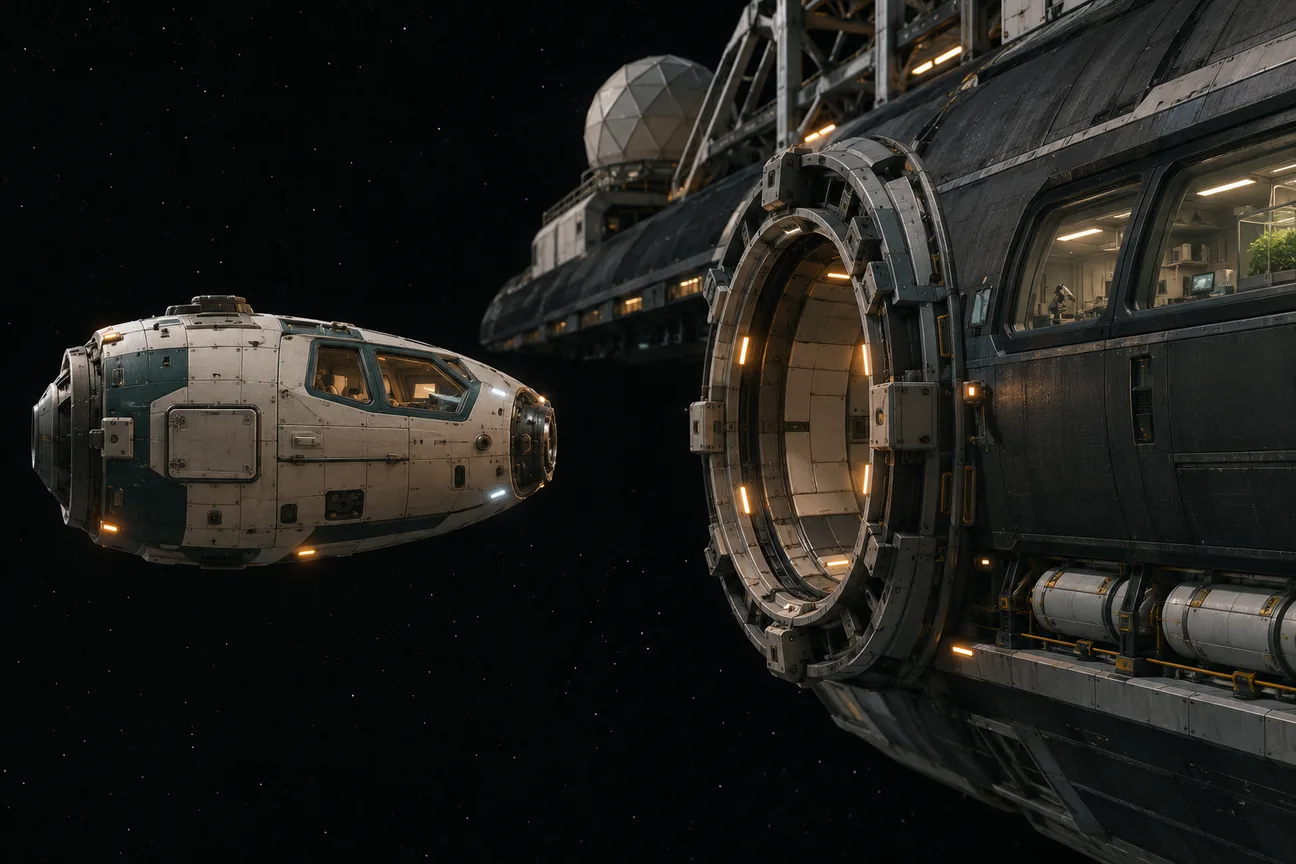
Hold and recovery
Hold for loss of live lock, stale host evidence or excessive port translation or rotation. Obtain a fresh window before retrying and a separate physical capture confirmation. Check required dock services and receiving readiness before a sample crosses.
Model and references
Open the interactive cycleZENIT concept procedure. Models and replays use illustrative conditions.