Space research ·
The alpha particle behind KETS
In ZENIT’s early Zorak study, the “KETS particle” has a familiar name. It is an alpha particle, the fast helium nucleus born in fusion. The question for the ship is how much of its energy the reactor can spare.
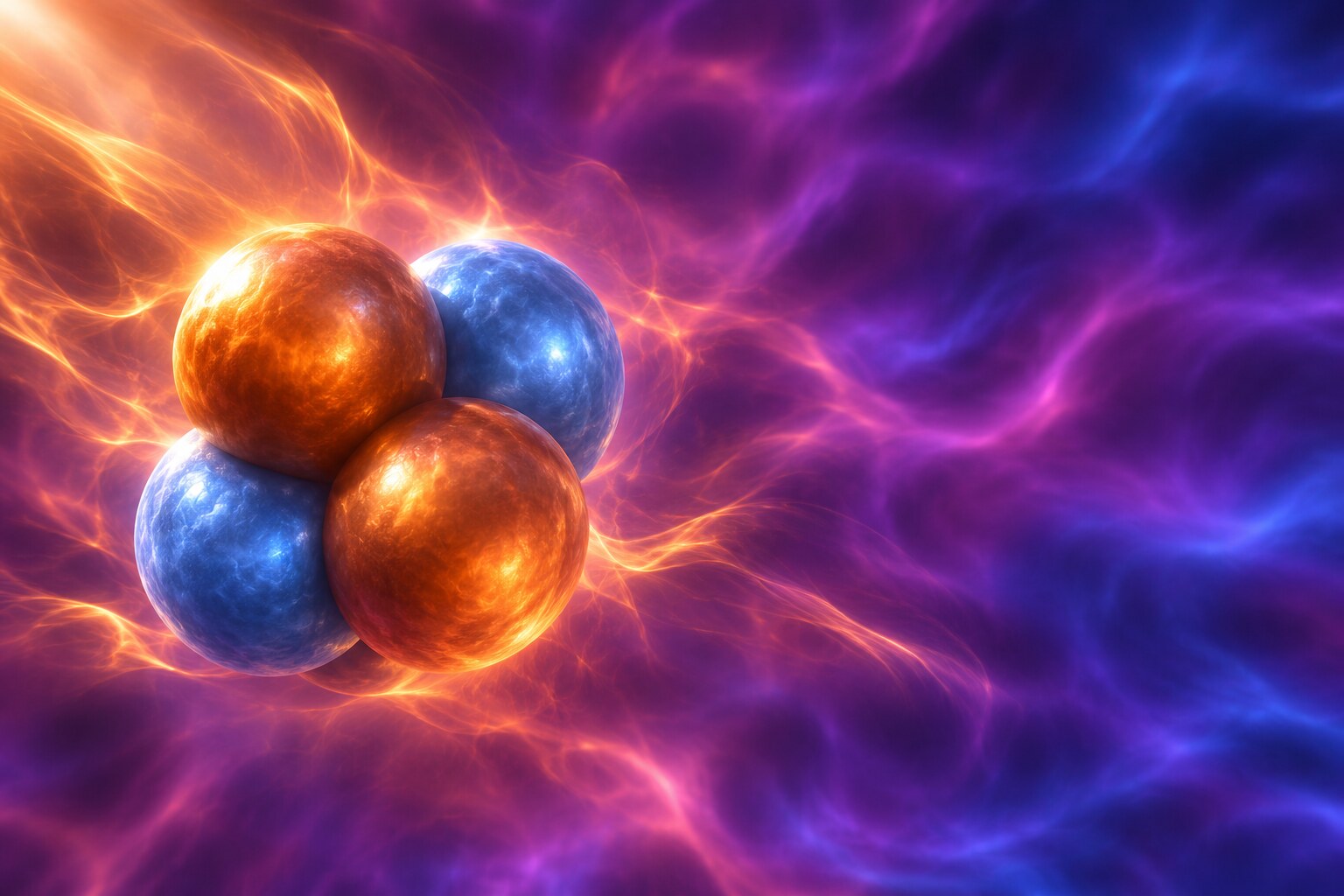
The idea began with Centri. On 22 November 2026, a ZENIT design discussion considered whether the ship could recover energy from rotating machinery such as turbines and flywheels. KETS stood for Kinetic Energy Transfer System. That prompted a question about the reactor itself. Before the particles heated the plasma or any turbine turned, could the ship recover some of their energy directly? Zorak’s two fusion cores gave the team a case to calculate.
How alpha particles heat the fuel
The early study assumed deuterium and tritium, two forms of hydrogen. When their nuclei fuse, they produce a helium-4 nucleus and a neutron. The helium nucleus has two protons, two neutrons and a positive charge. It leaves the reaction with about 3.5 million electronvolts of kinetic energy. The uncharged neutron carries about 14.1 million electronvolts, roughly four fifths of the total.
That split matters. A magnetic field can confine the alpha particle. As it slows through collisions, it heats the surrounding fuel and helps the next fusion reactions occur. The neutron can escape magnetic confinement and deposit its energy in surrounding material. Recovering the charged share early could give Zorak electricity, but it could also take away heat that sustains the burn.
There is a real experimental precedent for part of that idea. In 1977, researchers at Lawrence Livermore Laboratory used a hydrogen plasma source to test a direct converter. An electric field slowed incoming ions so the apparatus could recover some of their kinetic energy as electricity. The measured efficiency depended on the beam conditions. Whether a burning ZENIT plasma could supply spare alpha energy is a separate question.
What happened in Zorak’s pulse
On 23 November, the simulation held fusion output at 213.19 MW. First core A diverted particle energy, then core B joined it. At full pulse the two branches diverted 10 MW in total. The model assumed 70% conversion and 95% delivery. Of the 10 MW diverted, 7 MW emerged as electricity and 6.65 MW reached the ship’s electrical bus. The original heat-to-electricity route would already have supplied 3 MW from that energy. Running the cooling pumps cost another 0.10 MW. That left a net gain of 3.55 MW.
SERAT, the ship’s electrical distribution system, passed power to the stern drives. The drives still had to expel propellant to produce thrust. With surplus particles, modeled combined thrust rose from 1,028 N in bypass to 1,086 N at full pulse. Across the 160-second pulse, that amounted to about 0.0118 millimetres per second of extra speed for the assumed 690,000-tonne Zorak.
Then the study changed one assumption. If the plasma needed all 10 MW back as heat, the modeled heater drew 12.50 MW of electricity. The ship’s net electrical supply fell to 55.01 MW, below the 63.96 MW available in bypass. The same particle and the same converter produced opposite answers about whether recovery helped.
What Gen 2 still has to establish
The 27 November Gen 2 study worked backwards from a target of 99.91 MW of extra electricity per wing. Under its assumptions, each wing would need about 274 MW of divertible particle power and 82 MW of dedicated cooling. For scale, Zorak’s entire earlier 213.19 MW fusion case would produce only about 43 MW in alphas at birth, before any heated the fuel. Gen 2 therefore needs evidence for a much larger source. Its calculation gives an electrical requirement and no measured thrust.
The distinction carries through to Earth. The Norak and Marak approach study asks whether electricity stored before entry could run a fan later. There, the fan pushes atmospheric air and the particles stay out of the propulsion path.
ZENIT proposes Centri for the first hardware comparison. At matched fusion output, compare the electricity available with recovery on and in bypass, including replacement heating, pumps and rejected heat. Anorak would independently check the balance. We know which particle the early study meant. What remains to be measured is how much energy the ship can take from it while keeping the plasma burning.