ZENIT Earth
Enable JavaScript for search, architecture views and the factbook.
Open Space Program →
· Fleet announcement
KETS motion across the Qi Fleet
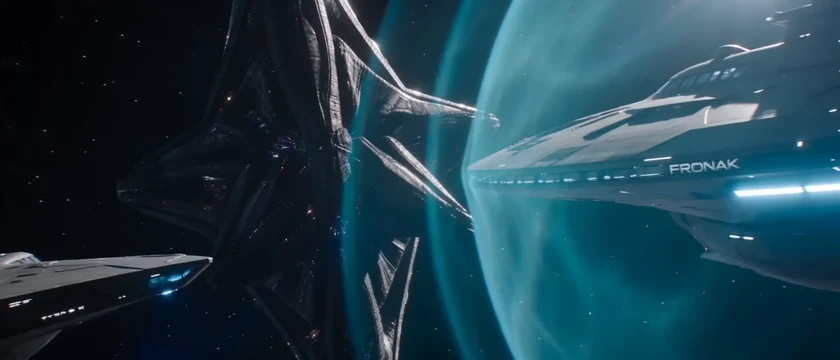
The Qi Fleet now has a vessel-by-vessel design for KETS-1, a short propulsion pulse that recovers electricity from surplus fusion particles.
+5.65% modeled thrust on Zorak
Three-minute maximum in the fleet study, including startup and return to bypass.
Fusion Power Facility
A single stellarator-derived plasma fusion core with separate energy and safety islands.
Planning baseline · Sources S2, S3, C1
- Thermal design target: 5.30 GWth
- Grid design target: 2.00 GWe
- Architecture: Integrated Architecture R3
- Core arrangement: Single-Core Earth Fusion R1
- Working matter: Magnetically confined fuel plasma
- Earth shield concept: GENI Inverse · five layers
The design uses one steady-state stellarator-derived core. Fuel becomes plasma inside the vacuum vessel. Shaped coils provide the confinement field, and separate cooling and conversion equipment transfer useful energy. The output figures are design targets.
The Fusion Island and SERAT Energy Island remain separate. GENI Inverse Shield Mode is the Earth shielding concept. Earth requirements do not automatically transfer to Space systems.
WP3 defines quench protection and tritium inventory work. Fuel-cycle selection, conductor design, physical tests and independent release remain open.
Fleet shield integration does not change the single-core Earth fusion baseline, its separate five-layer Inverse geometry or independent local protection requirements. The stated plant outputs remain design targets.
SERAT Energy Island
A separate plant energy and thermal network for distribution, recovery and useful work.
Planning baseline · Sources S2, S5
- Interface: Separate from Fusion Island
- Scope: Power routing, cooling and recovery
The energy island receives controlled transfers and manages energy and thermal loads. Its functions do not replace the Fusion Island safety case.
The wider Earth vision applies SERAT to present energy sources as well as future fusion. No efficiency percentage or commercial output is assumed here.
Separate electrical input, usable heat, thermal losses, storage changes and actual heat rejection. The fleet reserve-accounting principle is shared; plant geometry, equipment and acceptance remain application-specific.
ZC-1 · Hydrogen Car
A hydrogen combustion vehicle with controlled pressure and vapour handling.
Concept · Sources C1
- Drivetrain model: Hydrogen combustion
- Pressure integrity: SERAT-APRS-V1
- Vapour regulation: SERAT-EVR-1
- Access / security: ZAR-A…F / ZSL-0
The hydrogen combustion engine transfers mechanical power to the wheels through the drivetrain.
Vapour regulation avoids road water discharge in the concept.
ZA-1 · Hydrogen Jet
A passenger aircraft concept with distributed anti-ice and isolated thermal loops.
Concept · Sources C1
- Passenger design range: 350–420
- Cruise design target: 39,000 ft
- Anti-ice: SERAT-DTAI-A1
- Wing heating: Two separated closed secondary loops
The passenger and altitude values are design targets for the transcontinental hydrogen combustion jet.
Isolated nacelle heat exchangers transfer exhaust heat into two physically separated secondary loops. The qualified low-freezing heat-transfer fluid remains to be selected.
Raw exhaust and combustion vapour stay on the engine side of the heat exchangers. Airworthiness and physical qualification remain open.
ZA-P01 · Propeller Aircraft
Hydrogen combustion in the nacelle drives a turbine, gearbox and propeller.
Concept · Sources C1
- Power path: Turbine → gearbox → propeller
- Combustion location: Nacelle
ZA-P01 is a separate propeller aircraft branch. Its nacelle arrangement should be studied on its own requirements and safety basis.
ZH-1 · Hydrogen Helicopter
A helicopter concept organized around independent safety and reserve power paths.
Concept · Sources C1
- Recorded revision: Integrated Safety R2
- Status: Concept; certification not demonstrated
The recorded concept includes dual hydrogen systems, triplex controls and reserve-shaft arrangements. These are architecture concepts, not a certified aircraft configuration.
ZP-1 · Passenger Boat
Hydrogen passenger transport with an onboard safety architecture.
Concept · Sources C1
- Safety reference: Integrated Onboard Safety R1
- Onboard protection: Conventional marine systems
The concept uses protected hydrogen storage, gas detection, ventilation, fuel isolation and fire protection.
Emergency shutdown and passenger evacuation form part of the onboard safety model. The vessel systems require marine qualification.
ZB-1 · Sports Boat
A compact hydrogen boat with a defined dimensional and passenger target.
Concept · Sources C1
- Length / beam targets: 17.5 m / 4.8 m
- Mass reference: 24 t
- Persons: 10
- Speed target: 35–40 kn
Dimensions, mass, persons and speed are working concept references. They do not establish stability approval, payload certification or demonstrated speed.
ZCS-1 · Hydrogen Cruise Ship
A recovered cruise-ship concept with direct mechanical propeller propulsion and a new auxiliary pump-jet manoeuvring proposal.
Concept · Sources S7, S8
- Main propulsion: Twin controllable-pitch propellers
- Machinery in original schematic: 4 hydrogen engines / 2 engine rooms
- Hydrogen zoning: 4 isolated liquid-hydrogen blocks
- New manoeuvring proposal: Auxiliary steerable bow & stern pump-jets
The recovered 29 July 2026 design is a separate cruise-ship branch. Hydrogen-combustion engines drive combining reduction gearboxes, shaft lines and twin controllable-pitch propellers. Hotel-service generation is separate from propulsion.
The original schematic places four isolated hydrogen blocks low and amidships, below occupied passenger and service decks. Illustrative equipment details do not establish a qualified vessel installation.
The new manoeuvring proposal adds auxiliary steerable pump-jets near the bow and stern, with hydrogen-driven auxiliary machinery and hydraulic power transfer. The two positions shown are a layout study; unit count, power, thrust and ship response remain to be determined.
LSI · Infrastructure Intelligence
A human-readable view of facilities, environmental consequences and system state.
Framework · Sources S5, C1
- Meaning: Living Systems Intelligence
- Earth role: Operational model and operator view
LSI makes complex Earth-system information understandable. NEXUS coordinates and predicts; LSI presents the wider operational and environmental picture.
Any future live display needs source validation, timestamping and clear separation between observation and authority. This document contains reference data only.
Human-readable state displays must retain missing or conflicting observations as unassessed and distinguish design targets, simulated results and measurements.
SafeSpots & Resilient Facilities
Three Earth infrastructure concepts for supporting essential services during outages.
Research scope · Sources S5
- Reference scope: Core Principles slides
- Requirements: Not detailed in the loaded sources
The SafeSpot concepts cover Standard, Critical Continuity and Hardened All-Hazards study scopes. The Critical Continuity example models essential power, local operations and recovery during a winter outage.
Earth Medical & Hospital Research
A conceptual hospital framework connected to the wider ZENIT medical program.
Research scope · Sources C1
- Hospital reference: ZEH-FD-R1
- Shared research: ZCEMT-R1 / ZCDTC-R1
The recorded medical framework includes ZSBIA-R1, IMSI and MSO, with conceptual cancer-treatment and chamber references ZCEMT-R1 and ZCDTC-R1.
These labels organize research. They do not establish clinical effectiveness, treatment protocols or medical approval.
Integrated Infrared Systems
Thermal monitoring and inspection across Earth vehicles, plants and facilities.
Integrated concept · Sources C1
- Integration: September 2026
- Primary use: Sensing and diagnosis
Coverage includes plant hotspots, engine and exhaust diagnostics, thermal loops, fire detection, low-light awareness and remote inspection.
Use appropriate qualified sensors and separate diagnostic recommendations from autonomous protection.
Use valid calibration, observation age and uncertainty for every host. Diagnostic advice must remain distinct from independently qualified protective action.
ZENIT Academy & Learning
An educational branch for explaining systems, safety and the program architecture.
Research scope · Sources C1
- Existing material: Academy HTML and school subject program
- Atlas scope: Program reference and source index
ZENIT Academy teaches the decisions behind the program’s models. Earth Academy starts with an outage exercise at the proposed Earth Research Facility.
Long-term Earth Research
A place to organize unresolved energy, infrastructure and environmental questions.
Research scope · Sources S5, C1
- Principles: Equilibrium, energy responsibility, human survival
Long-term Earth research includes unresolved energy, infrastructure and environmental questions. Research hypotheses remain separate from established measurements and validated engineering results.
Norak-class Earth landing base
R3 concept clearances and loads alongside the original R4 platform and replay.
R3 fit study · R4 reference model · Sources N1, C1
- R3 study deck: 166 × 140 m
- R3 clear guide: 132 × 112 m
- R3 reference braking demand: 39.33 MN
The existing base concept is reconfigured for Norak-class vessels. Four adjustable cradle/capture carriages reserve provisional receiving stations distinct from the six onboard GENI support interfaces.
Selected dimensions show a fit study; receiver compatibility, structural load ratings, soil response, field maps and cooling remain open. Enlarging the structure does not validate an increased magnetic-force capacity.
A matched geometry or a valid navigation estimate does not establish support capacity. Preserve onboard support until an accepted base/cradle handover condition is actually met.
AXIOM
Enforces the permitted envelope and independent physical veto through phase-specific protective action.
Framework · Sources S2, S4, S5
- Boundary: Cannot block autonomous protection
- Role: Final physical veto; independent protection retained
AXIOM applies safety constraints to permitted operation. In the Earth qualification baseline, it may impose a more conservative hold or shutdown, but may not block an autonomous magnet-protection trip.
The July document also describes AXIOM as governing laws and objectives. These study pages preserve that conceptual role while using the later Earth safety boundary where it applies.
Protective action depends on the operating phase. Space hold, docking hold and atmospheric flight have different contingencies; a shield fault must not blindly remove unrelated propulsion or essential flight support.
NEXUS
Turns telemetry and models into diagnosis, prediction and coordination.
Framework · Sources S1, S2, S4
- Role: Supervisory digital twin
- Safety authority: Cannot override independent local protection
NEXUS supports understanding, trend analysis and recommended action. It does not replace independent local protection or the ZENIT Safety Authority.
For Earth fusion it cannot alter trip thresholds, suppress protection, erase validated records or reconcile away an unexplained inventory discrepancy.
Track sensor identity, time, frame, validity and uncertainty. Separate a requested response, measured actuator/field state and verified protective effect; missing data remains unassessed. Supervisory or fleet-link loss must not disable local interlocks.
SERAT
Routes protected energy, manages heat and coordinates recovery.
Framework · Sources S1, S2, S4, S5
- Role: Energy and thermal management
- Boundary: Separate from primary energy generation
SERAT manages distribution, thermal loops, cooling, recovery and safe energy discharge. GENI manages field interaction; neither replaces the other.
Earth fusion retains a separate SERAT Energy Island. Space uses protected power corridors and separate distribution trunks under the vessel architecture.
Maintain one concurrent electrical and thermal account for shield, propulsion, essential services, cooling auxiliaries and recovery. Count each reserve once; stored energy needs a rated recovery or dissipation path and is not automatically useful recovered power.
GENI
Coordinates scoped field requests, propulsion interaction and available resources under local protection.
Concept · Sources S11, S1, S2, C1
- Current framework: GENI R1
- Earth / Space: Use scoped shield modes
GENI coordinates proposed electromagnetic settings with NEXUS observations, the local reference, and SERAT power and cooling limits. AXIOM retains physical permission.
Earth fusion uses the five-layer GENI Inverse concept. The Space Outverse control map has 25 regions. Each claimed protective effect requires hazard-specific measurement.
For shielded vessels, GENI requests adaptive control across five layers and five sectors. Local coil controllers regulate measured hardware; CMC supplies the reference. Sensor feedback does not by itself establish protective field effectiveness.
ZENIT Safety Authority
Owns independent acceptance, hazard closure and configuration control.
Governance · Sources S2, C1
- Abbreviation: ZSA
- Independence: From command, NEXUS and plant systems
ZSA owns the hazard log, approved test procedures, deviations, anomaly closure and final acceptance decisions.
Qualification requires evidence tied to the exact hardware, software and settings. A simulation result alone does not close a physical qualification gate.
Keep simulated logic, bench measurements, integrated tests and accepted operational capability as distinct evidence stages. An offline controller result does not close physical shield, propulsion or entry qualification.
Infrared sensing · ZIR-R1
Adds thermal imaging, diagnostics, navigation support and scientific observation.
Integrated concept · Sources C1
- Scope: Earth and Space
- Role: Sensing and diagnosis
The September integration covers condition monitoring, fire and hotspot detection, low-light awareness, thermal-loop and engine diagnostics, remote inspection, obstacle sensing and scientific infrared spectroscopy where appropriate.
Sensor data feeds processing and NEXUS diagnosis. SERAT and GENI responses remain within AXIOM constraints and independent safety governance. Infrared sensing is not a substitute for qualified safety protection.
Thermal observations carry calibration, age, uncertainty and a valid field of view. Cross-check against appropriate independent measurements; infrared sensing does not guarantee detection of every cold, fast or obscured hazard.
Telemetrics
Checks the origin, freshness and reliability of readings before they inform operating decisions.
Integrated concept · Sources S10
- Inputs: Campus sensors and SafeSpot service meters
- Operator view: NEXUS interprets readings. LSI shows conditions and confidence.
- Safety boundary: AXIOM retains physical authority. Local protection can act during link loss.
The verification gateway checks source identity, age, sequence, message integrity and plausibility. In the Earth station model, a stale water-level reading holds the affected regional status update until a fresh sample is checked.
The local event recorder preserves the reading, its quality flags and the operator’s decision. The campus shares selected status through its regional reporting links.
LSI
Explains facility state and environmental consequences in human-readable form.
Framework · Sources S5, C1
- Meaning: Living Systems Intelligence
LSI is the Earth information view. It presents and contextualizes observations without replacing independent safety authority.
Independent Local Protection
Initiates protective action without waiting for a supervisory network.
Qualification requirement · Sources S2
- Earth magnet rule: Autonomous detection and discharge
- Restart: Controlled authorization required
A qualified protection chain acts despite loss of NEXUS, plant network, main AC or operator workstation. Diverse sensing and protected local power support this independence.
Local fault protection remains available without supervisory communications. Discharge, isolation, restart and any vehicle safe-state response require their own measured conditions; elapsed time alone does not establish readiness.
Source references
S1 · Core Architecture · Single File · Space energy chain; CMC, GENI, IRSI, fuse chambers, SERAT and Vector Accelerator. Conceptual educational reference. Original reference
S2 · Fusion Qualification · WP3 R1 · ZFPQ-WP3-R1. Authoritative for the Earth quench and tritium qualification work packages. Definition complete; physical execution open. Original reference
S3 · Critical Capability Register · R1 · ZFCCR-R1. 32 planning risks and 10 decision gates; supplier and test-capacity candidates. No confirmed procurement or test booking. Original reference
S4 · Canonical Engineering Baseline · v1 · Earlier conceptual framework: subsystem separation, fleet roles, AGCM and operating principles. Later scoped revisions take precedence. Original reference
S5 · Core Principles · Selected Slides · Purpose and common principles: Earth energy, mobility, SafeSpots, LSI, environmental responsibility; Space exploration and survivability. Older mobility diagrams are not the current drivetrain baseline. Original reference
S6 · Outverse Shield · Five Layers / 25 Regions · Restored original vessel architecture: five concentric layers across five hull sectors. Earlier single-sector simulation references retain their original limits. Original reference
C1 · ZENIT working project context · Working project context includes mobility specifications, the 24 July fleet flight design, fleet docking doctrine, Frequency Travel research, Drone Integration R2, QVCO-R1, recorded model exercises, medical projects and infrared integration. The underlying specification files were not loaded for these entries.
S7 · ZCS-1 · Recovered Mechanical Propulsion Schematic · Recovered cruise-ship architecture: four isolated hydrogen blocks, two engine rooms, reduction gearboxes, shaft lines and twin controllable-pitch propellers. Historical labels and equipment drawings are preserved as artwork. Original reference
S8 · Steerable Marine Pump-Jets · Technical Background · Established steerable pump-jet principle for marine manoeuvring. Background for the new ZCS-1 auxiliary proposal; no manufacturer unit, power rating or validated installation is selected. Original reference
S9 · Seven Developments · Z7DP-R1 · Seven documented reference designs and offline prototypes; 69 software checks and 969 selected reference/fault scenarios. Hardware measurements, installation values and physical qualification remain open. Original reference
N1 · Norak / QAC-1 R1 and Norak-class landing-base R4 · Norak reference geometry, fleet integration and selected base layout. Flight, field and structural qualification remain open. Original reference
N2 · Centri restoration and Qi fleet reconciliation R1/R2 · Centri coordination and recovery roles, retired circular hull, provisional CFH-M1 envelope, Ranok reserve research role and reconciled 17-entry roster. No physical qualification imported. Original reference
S10 · ZENIT Telemetric Integrity Architecture · Reading verification, Earth LSI and SafeSpot reporting, the Qi Fleet telemetry unit and coordination chamber, and illustrative stale-data and link-loss examples. Original reference
S11 · GENI · Coherent interaction architecture · Field coordination under AXIOM limits, hazard-specific shielding evidence, SERAT energy accounting, vessel momentum and FCMC-1 readiness. Original reference
TR1 · Qi Fleet research register · Trell R1 · Docking permission, independent capture, equal-load energy, detector evidence and custody. Proposed host interfaces require individual verification. Original reference
Contact ZENIT
zenitpro50@gmail.com
Drone models
Space Stories · Optem mission archive
ZENIT Model Atlas — 3D models, system maps and the design archive
Plasma fusion cores and their operating sequence
Videos — ZENIT Earth and Qi Vanguard Fleet concept films
Hierarchy — program roles, access ranks and security levels
Telemetrics — how ZENIT checks readings and retains local safety authority
Vitality Functions — SERAT, GENI, AXIOM, NEXUS and LSI
Operations — Earth and Space procedures
Propulsion illustrated · Planetary Roadsters
Reports — Earth and Space costs and climate evidence
SafeSpots — Earth infrastructure and outage study · ZENIT Academy
Fusion Facility model
ZC-1 car model · ZA-1 jet model · ZP-1 boat model